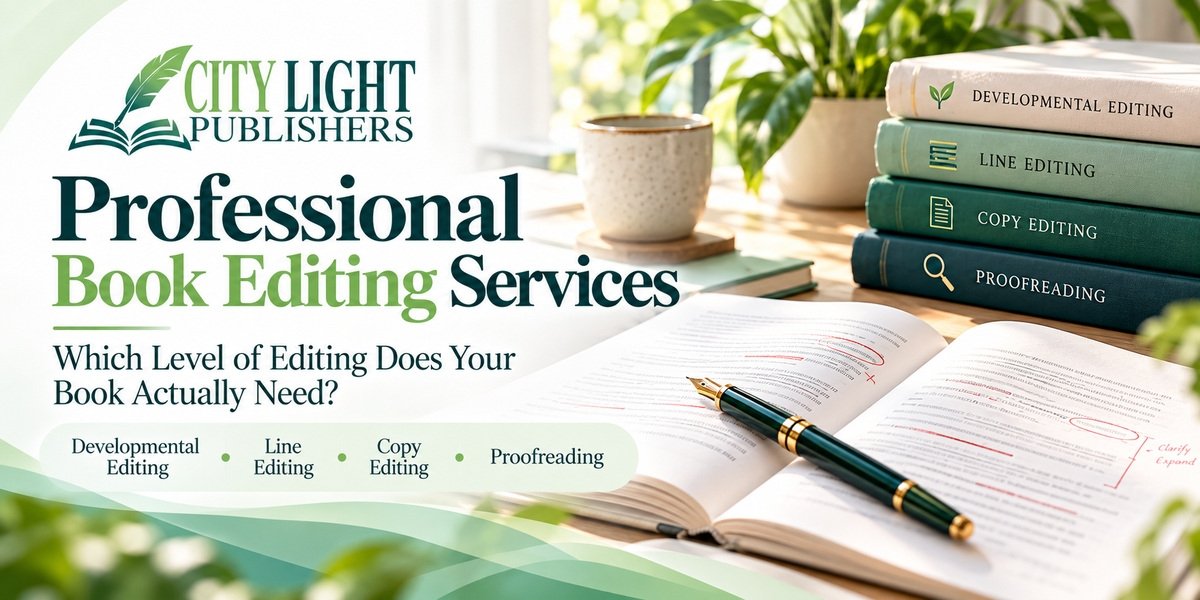

Choosing the right professional book editing services can make a major difference in the quality of your manuscript, your publishing timeline, and your overall budget.
Many first-time authors make the mistake of selecting an editing service too early or choosing the wrong level altogether. A manuscript that still needs major structural changes may be sent for copy editing, while another manuscript that is already structurally strong may receive an expensive developmental edit it does not need.
Both situations can waste valuable time and money.
City Light Publishers organizes its editorial process around different stages, including book editing, children’s book editing, proofreading, and formatting. Understanding what each level does can help authors choose the right book editing service at the right stage of publication.
Understanding the Different Levels of Book Editing
Not every manuscript requires the same type of editing. Each editorial stage focuses on a different aspect of the book.
Developmental Editing
Developmental editing looks at the book as a complete work rather than concentrating on individual sentences.
A developmental editor may evaluate:
- Overall structure
- Chapter organization
- Story pacing
- Character development
- Point of view
- Plot progression
- Opening chapters
- Ending effectiveness
- Nonfiction arguments and organization
For fiction, developmental book editing may examine whether characters are actively driving the story and whether important conflicts develop naturally.
For nonfiction, the editor may evaluate whether arguments are introduced clearly, logically organized, and supported throughout the manuscript.
A developmental edit can result in chapters being reordered, shortened, combined, rewritten, or even removed.
This stage often includes an editorial letter containing detailed feedback and recommendations.
Line Editing
Line editing services focus on how the manuscript reads rather than its overall structure.
Once the story or argument is working effectively, a line editor concentrates on improving the writing itself.
This may include:
- Sentence rhythm
- Clarity
- Word choice
- Paragraph flow
- Repetition
- Dialogue
- Transitions
- Tone
- Readability
The goal of professional line editing is to improve the reading experience without changing the fundamental structure or purpose of the book.
If readers understand your story but feel that reading certain sections requires too much effort, line editing may be the appropriate next step.
Copy Editing
Copy editing services focus primarily on correctness, consistency, and technical accuracy.
A professional copy editor may review:
- Grammar
- Spelling
- Punctuation
- Usage
- Style consistency
- Continuity
- Internal references
- Basic factual inconsistencies
- Capitalization
- Formatting consistency
A professional copy editor may also create a style sheet that records editorial decisions made throughout the manuscript.
For example, the style sheet may track spelling preferences, character names, capitalization choices, dates, terminology, and other details that need to remain consistent throughout the book.
Copy editing should generally take place after major structural and stylistic revisions have been completed.
Proofreading
Book proofreading services represent one of the final editorial stages before publication.
Proofreading should normally happen after the manuscript has been edited, finalized, and typeset.
A proofreader looks for remaining issues such as:
- Typographical errors
- Misspellings
- Punctuation mistakes
- Incorrect spacing
- Formatting problems
- Bad page or line breaks
- Errors introduced during typesetting
Unlike developmental editing or line editing, proofreading is not intended to rewrite the manuscript.
A professional proofreader should make careful corrections without introducing unnecessary changes into a file that is almost ready for publication.
How Do You Know Which Book Editing Service You Need?
Choosing between developmental editing, line editing, copy editing, and proofreading can be difficult, especially for first-time authors.
A few simple questions can help.
Can You Explain Your Book in Two Sentences?
If you struggle to explain your book’s central argument, storyline, or narrative arc clearly, you may need developmental editing services.
This usually suggests that the manuscript still has structural issues that cannot be solved through sentence-level editing.
Do Readers Lose Interest in the Middle?
If beta readers enjoy the beginning but say the middle becomes slow or difficult to continue, the problem may be structural.
Weak pacing can sometimes indicate that characters lack clear goals, conflicts have weakened, or the manuscript has sections that do not move the story or argument forward.
That is usually a developmental issue.
Is the Structure Strong but the Writing Feels Heavy?
If readers understand and enjoy the book but say it feels difficult to read, line editing may be more appropriate.
The underlying structure may already work well, but the prose could benefit from improvements in clarity, rhythm, and flow.
Have Major Revisions Already Been Completed?
If your manuscript has already gone through structural revision and line-level improvement, it may be ready for copy editing.
At this stage, the goal is consistency and correctness rather than significant rewriting.
Is Your Book Already Typeset?
If the book has been formatted and you are preparing to publish, professional proofreading services are usually the correct final editorial step.
Major rewrites at this stage can create new formatting issues and delay publication.
Why Children’s Book Editing Requires Specialized Experience
City Light Publishers treats children’s book editing services as a separate editorial area because children’s books have requirements that differ significantly from adult fiction or nonfiction.
A children’s book editor may evaluate:
- Age-appropriate vocabulary
- Reading level
- Sentence length
- Developmentally appropriate concepts
- Page-turn pacing
- Relationship between text and illustrations
- Story length
- Ending effectiveness
For picture books, an editor must also understand how much storytelling should be handled by the words and how much should be left to the illustrator.
An editor who works effectively with adult literary fiction may not automatically have the specialized knowledge required for children’s book editing.
How Long Does Each Editing Stage Take?
When choosing professional book editing services, authors should consider more than price.
Editing can also affect the publishing schedule.
Developmental editing often creates significant revision work for the author. If an editor recommends restructuring chapters, strengthening characters, or reorganizing an argument, revisions may take weeks or even months.
Line editing can also require several weeks of revision.
Copy editing generally requires a shorter review period because the manuscript should already be stable.
Proofreading typically requires the least amount of author revision because it happens close to publication.
Planning the editorial process around your launch date can help prevent rushed revisions and an under-edited final book.
Questions to Ask Before Hiring a Professional Book Editor
Before hiring a professional book editor, make sure you understand exactly what the service includes.
Important questions include:
- What level of editing am I receiving?
- What is excluded from the service?
- Will I receive an editorial letter?
- Will tracked changes be included?
- How many editing rounds are included?
- What happens if another editing round is required?
- Can I receive a sample edit from my own manuscript?
A sample edit can be especially useful.
Instead of relying only on polished portfolio examples, ask the editor to review several pages from your actual manuscript. This gives you a clearer idea of the editor’s approach and whether the working relationship feels suitable.
Why Developmental Editing Is Often Overlooked
When budgets are limited, authors sometimes skip developmental manuscript editing because it requires significant work after the editor returns the manuscript.
Copy editing can feel more immediately satisfying because the author receives a cleaner document without having to rethink entire chapters.
However, sentence-level polishing cannot correct major structural problems.
A book with a strong structure and a few minor errors can still offer readers a satisfying experience. A perfectly polished book with weak pacing, unclear arguments, or a collapsing story structure may still struggle to hold attention.
That is why understanding your manuscript’s biggest problem should come before deciding which editorial service to purchase.
The Correct Book Editing Sequence
A professional editorial workflow generally follows a logical sequence.
Start with developmental editing when major structural changes are required.
Once the structure is stable, move to line editing to improve the quality and readability of the prose.
After that, copy editing can correct grammar, consistency, usage, and technical issues.
Then the manuscript can move into book formatting services and final proofreading.
Working through these stages in the proper order helps reduce unnecessary revisions and prevents authors from paying to polish material that may later be rewritten or removed.
Choose Professional Book Editing Services Based on Your Manuscript
The best editing service is not automatically the most expensive or comprehensive option.
It is the service that addresses the manuscript’s current needs.
Understanding the difference between developmental editing services, line editing services, copy editing services, and book proofreading services allows authors to make better publishing decisions.
Before purchasing an editing package, determine whether the problem lies in the book’s structure, prose, technical consistency, or final presentation.
City Light Publishers offers editing, proofreading, and formatting services designed for different stages of the publishing process. Choosing the correct stage can help authors improve their manuscripts efficiently while avoiding unnecessary editorial costs.