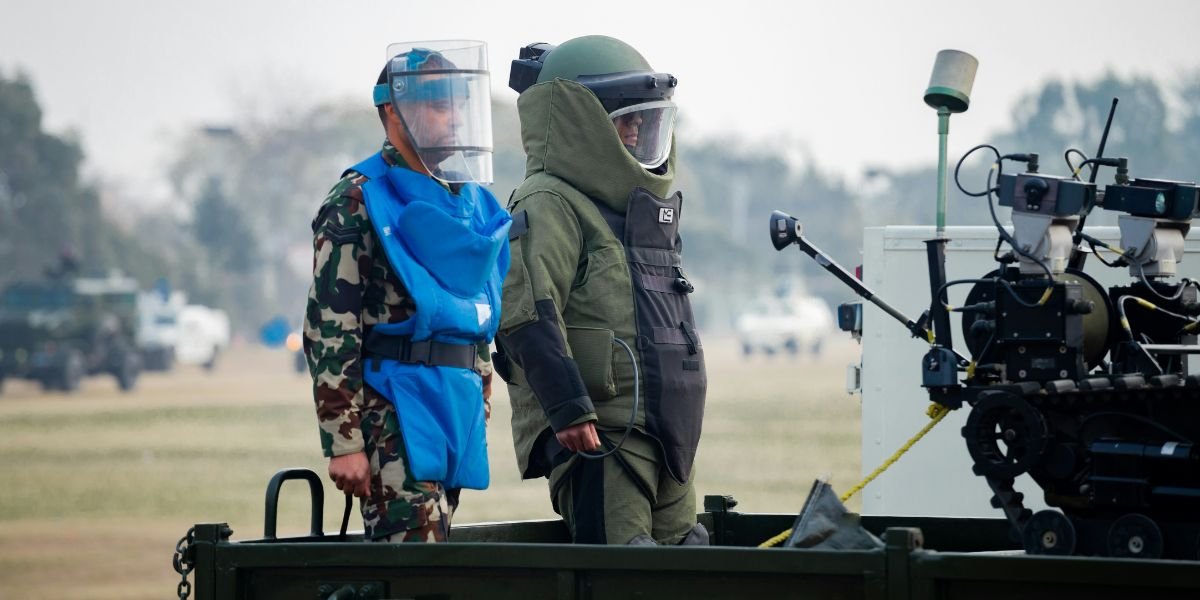

Plenty of military specialties test whether a candidate can perform under pressure. Explosive Ordnance Disposal demands something narrower and harder: clear thinking under pressure, often alone, with no real chance at a second attempt.
That requirement is why the Navy’s EOD pipeline lasts longer than almost any other enlisted training track in the armed forces, why it has historically dropped most of the people who begin it, and why those who finish bring the experience into every job that follows.
Christopher Portelli of Setauket, New York, is one of those graduates. He served as a United States Navy EOD technician and reached Petty Officer Second Class before spending the next two decades in engineering and executive leadership on Long Island.
The explosives are the least unusual part of the training. The schoolhouse stands out for making students act on partial information and then take full ownership of the result. Few institutions try to teach that on purpose, and it helps explain why EOD graduates tend to talk about their later careers in terms of decisions they owned more than titles they held.
Years after leaving the service, pipeline graduates can still be spotted by how they handle incomplete information when the stakes are high.
The Pipeline Is Long on Purpose
No single course turns a sailor into an EOD technician. Candidates pass through a series of schools, each one its own gate, spread over several bases, and the process usually takes a year to eighteen months before the new technician joins an operational unit.
It starts with a preparatory phase focused on water and physical conditioning, mostly so candidates don’t show up at dive school unprepared. Next, students go to the Naval Diving and Salvage Training Center in Panama City, Florida, to qualify as military divers.
After that, they report to the Naval School Explosive Ordnance Disposal at Eglin Air Force Base, Florida, a joint schoolhouse where Army, Navy, Air Force, and Marine Corps students, along with personnel from allied nations, learn the same core discipline. Navy students who finish at Eglin go on to parachute training and then tactical training on the West Coast before joining a mobile unit, where a work-up cycle extends their education by a year or more.
Every handoff between schools is another point where candidates drop, and the pipeline was built to work that way. Details have shifted over the years, but the overall structure has held steady for a long time, and it is the same structure Christopher Portelli went through before starting his engineering career on Long Island.
Water Comes First for a Reason
Navy EOD is the only branch of the specialty that requires every technician to qualify as a diver, since the Navy handles underwater ordnance, mine countermeasures, and the clearing of harbors and beaches. That makes dive school both a technical qualification and a screening tool.
It screens so well because underwater, people lose most of what normally keeps them calm. Visibility drops away, communication shrinks to a line pull or a hand signal, the gear adds complications, and a student who panics has no good outlet. Instructors pile on tasks until the load feels like too much, then watch how each student responds.
The strongest swimmers are seldom the ones who make it. Success goes to students who can keep working through a checklist while miserable, and the rest of the pipeline is designed around that same trait.
A Curriculum Built in Blocks
The schoolhouse at Eglin is divided into successive divisions, each covering one category of hazard, and students must pass each before advancing. The blocks cover core demolition principles, tools and methods, ground ordnance, air ordnance, improvised explosive devices, and weapons of mass destruction, with Navy students adding an underwater ordnance division that the other services do not take.
People who haven’t seen the structure up close are often surprised by two features. One is how much of it happens in a classroom. Students spend much more time memorizing ordnance families, fusing behavior, and procedural sequences than working outdoors, and many more students fail written tests than physical ones.
The other is how strict the gates are. A failed test usually earns a single retest, and failing twice in the same division ends the student’s time in the pipeline. Nobody gets to carry a weak block forward and fix it later, since a technician in the field can’t be partly right about a fuze. Graduates of that system, Christopher Portelli among them, usually bring a strong respect for documentation and sequence into their later work.
One Person Walks
The specialty’s defining doctrine is easy to say and hard to absorb. When it’s time to approach a device, one technician walks forward while the rest of the team stays back. The others support, monitor, and stay ready, but one person leads the approach and answers for the outcome.
The training builds that in from day one. Students are graded individually on practical problems, have to talk through their reasoning aloud, and live with the results of their own diagnosis instead of a group’s. The approach deliberately guards against what happens in most organizations, where responsibility for a decision spreads until no one actually owns it.
Christopher Portelli describes his own operating philosophy in nearly the same terms, saying a leader should own the entire problem instead of one piece of it and stay present when the work turns difficult. He didn’t pick that up in business school. He learned it in a training system that gave students no team to hide behind.
Attrition Is Information, Not Failure
EOD attrition has always been high, and the schools don’t apologize for it. Their reasoning is simple. If they graduate someone who freezes, guesses, or shades the truth about what they saw, that person’s team pays for it later.
The standard isn’t about any single student. It is built for the moment each technician will someday face alone, and every graduate of the school, Christopher Portelli included, passed gates designed with that moment in mind.
The reasons people wash out are also more ordinary than most outsiders assume. Fear accounts for few of them. Students more often fall behind under the academic load, fail to recover from a single bad block, or fall into a habit of small procedural shortcuts that instructors are trained to catch. Candidates who try to explain away a mistake usually don’t last, since the whole specialty relies on technicians reporting exactly what they found, even when they’re uncertain.
What the Training Leaves Behind
When former technicians talk about what stayed with them, they mostly mention process, with little said about adrenaline. They bring up the briefing before a task, and the honest debrief after it; the written checklist nobody skips because they’re tired; the willingness to say “stop” out loud; and the refusal to let hope stand in for facts.
Those habits travel well. They appear in the way a fire officer manages an incident, the way an operator builds a company from zero customers and zero infrastructure, and the way a manager shares bad news early instead of waiting for a better quarter.
Pipeline graduates generally say these habits outlast the uniform, and the evidence supports them. The vocabulary shifts over the decades, while the discipline underneath stays the same.
About Christopher Portelli
Christopher Portelli of Setauket is a business executive, engineer by training, and United States Navy Explosive Ordnance Disposal veteran. Since 2013, he has served as Managing Director and President of SONOTEC US Inc., the American entity of the German ultrasonic technology manufacturer SONOTEC GmbH, which he grew from a single employee and no customers into a fifteen-person organization supporting eight figures in annual revenue. He also owns Alpha Performance Clinic, a men’s health and hormone optimization practice with locations in East Setauket and Bohemia, New York.
He joined the Central Islip Fire Department in 2002 and served as Chief of the Department from 2019 to 2021, commanding emergency operations for roughly 180 volunteer firefighters. He holds a Bachelor of Science from the State University of New York at Plattsburgh and a Master of Business Administration from the New York Institute of Technology, and his work building organizations on Long Island spans defense electronics, industrial inspection systems, and ultrasonic sensing.
Why the Standard Holds
Every field faces pressure to ease a training standard once the people who set it drift far enough from the actual work. EOD has mostly held firm, since a poorly trained technician causes harm that is immediate, physical, and impossible to bury in paperwork.
The pipeline takes a long time because the judgment it builds takes a long time to form, and it stays selective because the job gets no easier on a technician’s average day.
People who will never handle ordnance can still learn from this. An organization ends up with whatever behavior its standards enforce, regardless of what its values statement says. When a schoolhouse sends home a capable but careless student, it is stating what it values, and each graduate takes that statement with them. Decades later, whether in a firehouse in Central Islip or an office in Setauket, it still shows in how people like Christopher Portelli work.