

By: STAGE IIX, Editorial Staff
For generations, the global language of luxury has been shaped by Europe’s great fashion capitals. Paris and Milan established traditions of craftsmanship, refinement and exclusivity that continue to influence how the world understands prestige.
Their influence is undeniable. Their model, however, is not the only expression of luxury worth considering.
America has its own history of creating extraordinary objects. Its most recognizable contributions to design have often emerged not from fashion ateliers, but from aviation, architecture, automotive engineering and industrial innovation. In these disciplines, excellence has been defined by precision, ingenuity, performance and the confidence to build something new.
What would happen if an American luxury fashion house drew from those traditions instead of attempting to recreate the aesthetic codes of Europe?
It is a question that makes J.CHRISTOPH, the American luxury handbag label founded by retired U.S. Air Force Special Operations pilot Jared Lilje, particularly interesting.
The emerging house approaches luxury through a perspective rarely found in the handbag industry: one informed by military aviation, engineering principles, historically inspired design and American craftsmanship.
Whether those foundations can support an enduring luxury house remains to be seen. But the ambition behind them raises a more compelling question about what American luxury might become.
America Has Its Own Language of Luxury
Luxury has never belonged exclusively to fashion.
A meticulously engineered automobile, a remarkable private residence or a beautifully designed aircraft can carry the same aspirational weight as a couture gown. What unites them is not category, but discipline: material quality, proportion, craftsmanship, restraint and the sense that every detail has been considered.
American design has often found its most powerful expression at that intersection of function and ambition.
The country’s traditions in transportation, architecture, aviation and industrial design have produced objects admired not simply for how they look, but for the intelligence behind them.
That offers a distinctive foundation for American luxury.
Rather than treating “American” as a geographic label, a luxury house can make it an organizing philosophy: precision over excess, innovation over imitation, confidence over convention.
J.CHRISTOPH presents an early example of how that philosophy might translate into fashion.
When Engineering Becomes a Design Signature
There is a difference between designing a product around an inspiration and developing a recognizable design language from it.
The former can produce a compelling collection. The latter can begin to establish a house identity.
For Lilje, aviation is not an aesthetic discovered through trend research. It is a discipline in which he spent much of his professional life.
That experience influences the way he approaches structure, proportion and mechanical detail. Across the J.CHRISTOPH collection, elements associated with aircraft construction are reinterpreted through leather, stitching, hardware and silhouette.
The J.Batten, for example, incorporates a handle attachment inspired by the control-cable systems of the C-5 Galaxy, an aircraft Lilje worked on for nine years and piloted for five. Other designs draw from historic aviation structures and early flight technology.
Those references have already been explored in the feature Where Heritage Begins. Their larger significance here is the consistency of the creative philosophy they establish.
A seam is not necessarily decorative. A fastening is not merely functional. A structural detail can become part of the brand’s visual identity.
That is where an enduring design signature begins: not in how loudly an object announces its inspiration, but in how naturally that inspiration becomes part of its character.
For J.CHRISTOPH, aviation functions less as a seasonal theme and more as a design vocabulary capable of evolving across collections.
American Craftsmanship, Global Materials
For luxury consumers, provenance matters. Yet the relationship between where an object is designed, where it is crafted and where its materials originate is more nuanced than a single country-of-origin label.
J.CHRISTOPH reflects that distinction.
The company states that its handbags are handcrafted in the United States, while materials vary by style. The Aero and Aero Luxe, for example, are crafted in the U.S. using imported Italian leather. Other pieces, including the Jacqueline and Aerial Express, incorporate grade-one American alligator leather and nubuck suede linings.
This is not a contradiction in the brand’s American identity.
A modern American luxury house does not need to reject exceptional global materials in order to express a distinctly American point of view. What defines the finished object is the creative vision directing those choices, the craftsmanship behind its construction and the consistency of the resulting design.
Italian leather does not make an American-designed and American-crafted handbag Italian in identity. Nor does domestic production alone make an object luxurious.
Luxury emerges from the relationship between material, design, execution and experience.
For J.CHRISTOPH, the opportunity is to combine exceptional materials with American craftsmanship inside a design philosophy that feels unmistakably its own.
What Separates a Luxury Label From a Luxury House?
The distinction between a luxury label and a luxury house is not simply price, packaging or beautiful photography.
An enduring house develops recognizable design codes, craft standards, client rituals, cultural associations and continuity.
It builds a world around the objects it creates.
For J.CHRISTOPH, several elements of that world are beginning to take shape.
Aviation provides the overarching creative direction. Engineering-inspired details introduce recurring visual codes. The names of pioneering women in flight give the collection a consistent narrative architecture. American craftsmanship establishes the manufacturing foundation.
The customer experience adds another layer.
The Jacqueline, one of the brand’s signature handbags, is available through a private, appointment-based online shopping experience, with pricing provided upon request.
That model creates a more personal environment in which to introduce the product, explain its craftsmanship and communicate the story behind the design.
For an emerging luxury house, however, these elements are foundations rather than proof of permanence.
A recognizable design language must remain coherent as future collections are introduced. Craftsmanship must remain consistent as production evolves. A private client experience must offer genuine value rather than exclusivity for its own sake.
The transformation from label to house ultimately depends on whether those qualities become inseparable from the name itself.
Outside its own channels, J.CHRISTOPH has also begun to gain recognition within the fashion community. In a recent Glamour Bulgaria feature, Dallas Fashion Week CEO Nataliya Nova pointed to the brand as an example of a label distinguished not only by its aviation-inspired design language, but by the larger story and purpose behind it.
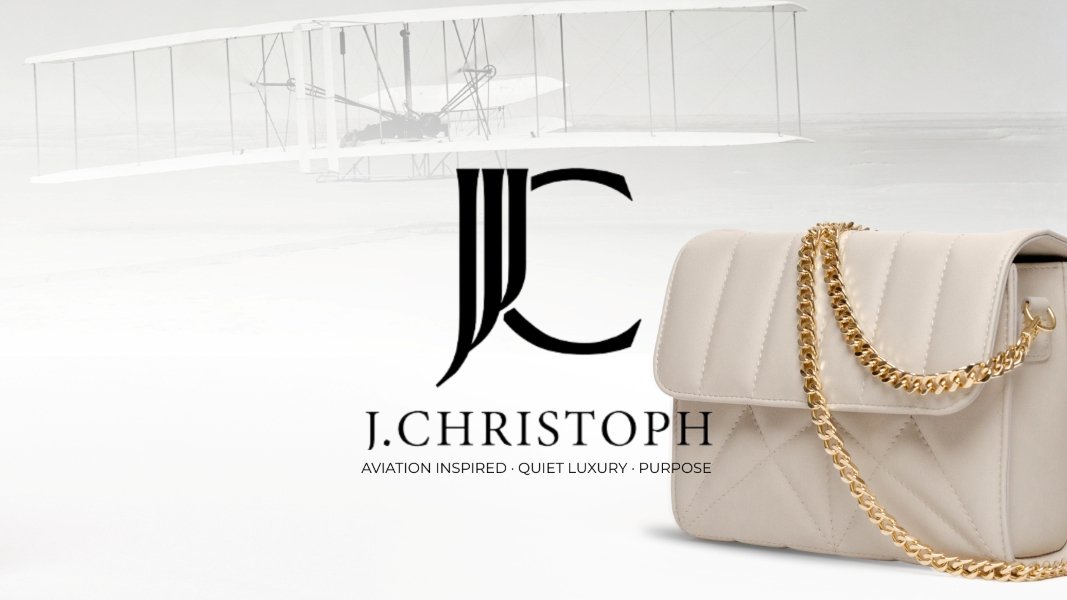
Creating a World Beyond the Product
A luxury house also has to stand for something beyond the object.
For J.CHRISTOPH, part of that identity is expressed through the women whose achievements helped shape aviation history.
The brand names its handbags after pioneering female aviators, including Jacqueline Cochran, Jean Batten and Raymonde de Laroche. The names reinforce a broader point of view centered on courage, independence and accomplishment.
Beyond the collection, J.CHRISTOPH also connects its visibility to its “Carry Hope” mission, focused on raising awareness around human trafficking and supporting organizations working in that space.
For younger luxury brands, these cultural and social associations can become part of the foundation of the house itself.
The important question is whether those values remain authentic and consistently reflected in the company’s actions as it grows.
The evolving visual language of the house can also be seen through J.CHRISTOPH’s official Instagram account, where product, aviation and the brand’s wider creative world begin to converge.