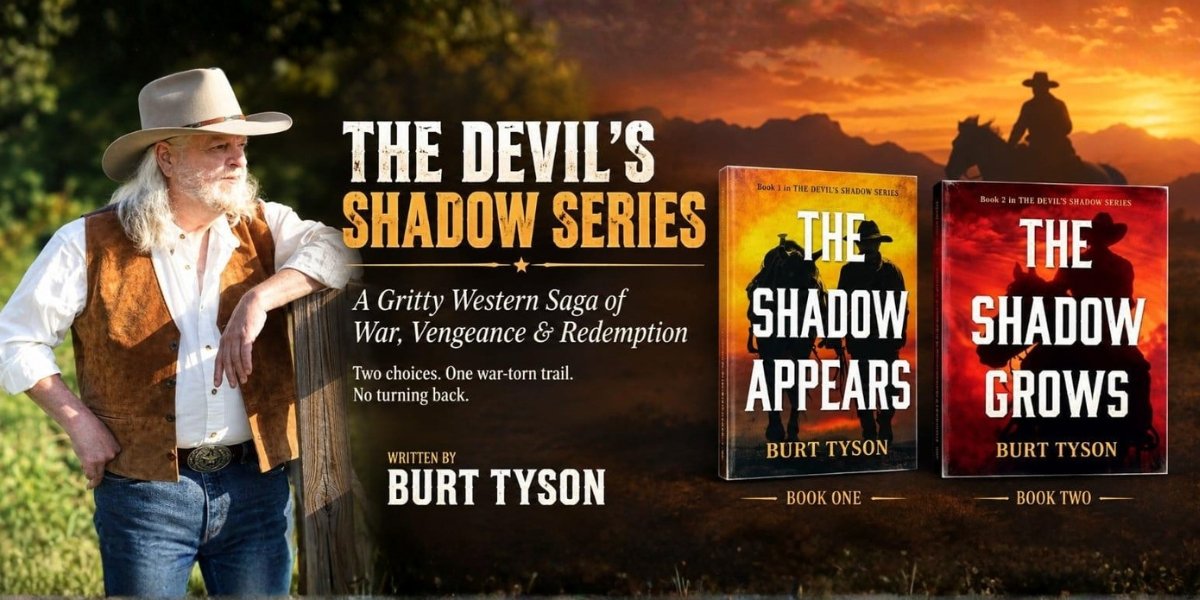

For James Van Laan, the Western is more than a literary genre. It is a lifelong passion and a powerful way to explore courage, loss, duty, faith, revenge, and redemption. Writing under the pen name Burt Tyson, Van Laan has finally returned to the dream of becoming a writer that first took hold when he was a teenager.
His journey to publication, however, was shaped by decades of experiences far removed from the Old West.
Van Laan grew up watching black-and-white Westerns on television during the 1950s. His fascination soon expanded to Western movies and novels, and by age 16, he had decided he wanted to become a writer. After college, life took him in another direction. Although he continued writing privately, he pursued careers in public relations, advertising, computer programming, and systems analysis. He eventually spent roughly 30 years working with a company whose database and systems were used by major hospitals.
After his wife’s death, Van Laan searched for a renewed sense of purpose. After years of struggling with the loss, he realized the dream he had carried since youth could give him a new direction. He returned to writing, resurrecting an ambition that had remained with him for more than five decades.
That return eventually became The Devil’s Shadow, a Western series built around a man forced to reconstruct his life after losing almost everything.
A Story Forged Through Loss
The emotional foundation of Van Laan’s series grew out of his own reflections on failure. After his business collapsed and his first marriage ended, he began thinking about losing everything and moving forward.
He found his metaphor in the aftermath of the American Civil War: a Confederate soldier who had lost his cause, beliefs, home, family, and sense of direction. That idea became the foundation for his Western series.
The series begins with The Shadow Appears, which establishes the protagonist’s journey. The Shadow Grows continues his transformation, while The Shadow Seeks the Home was discussed during the interview as the next installment. At the heart of the character is a conflict between a strong sense of duty and honor and an equally powerful desire for vengeance.
History Behind the Fiction
Van Laan’s storytelling is deeply rooted in historical research. His interest in the Civil War and its aftermath spans decades, and he places considerable importance on getting historical details right.
One of his inspirations is John Singleton Mosby, known as the “Gray Ghost,” whose Confederate Rangers operated behind Union lines in Northern Virginia. The complicated reputation of Mosby and his men, who were viewed as outlaws by the Union, provided Van Laan with a compelling historical tension.
The author also incorporates the little-known story of the Confederate diaspora that followed the Civil War. Some former Confederates traveled to Mexico, Cuba, Brazil, Europe, and other locations rather than surrendering and accepting allegiance to the Union. These historical movements helped provide the broader setting for his fictional narrative.
His research extends beyond famous figures and major events. Weapons, horses, geography, military movements, and everyday frontier details all contribute to the authenticity he seeks. Van Laan says he dislikes fiction that gets historical details wrong, and his decades of research reflect his commitment to creating a believable world.
The Conflict Between Revenge and Redemption
One of the strongest themes in The Devil’s Shadow is vengeance. The protagonist’s family is destroyed during the violence of the post-Civil War period, leaving him with a deep desire to settle the score.
Yet Van Laan does not treat revenge as a simple path to justice. Instead, he examines its destructive consequences. He wants readers to consider the complexity of pursuing vengeance while attempting to preserve one’s own humanity.
That moral tension also shapes the protagonist’s relationship with faith. Characters in the story view him differently: some see him as connected to darkness, while others see him as a protector of the helpless. Fate repeatedly places him in situations he never anticipated, including an encounter with an elderly Mescalero Apache woman who teaches him elements of her way of life.
Continuing the Western Tradition
Van Laan’s influences include classic Western television programs and films, as well as writers and characters from the Western tradition. Those stories helped shape his understanding of heroism when he was young, and now he hopes his own books can offer something meaningful to readers.
For younger audiences, he hopes to present characters who can inspire them to think about courage and heroism. For adult readers, he hopes the books provide an engaging story while showing a character who confronts extraordinary challenges and continues moving forward.
After decades spent pursuing careers outside literature and experiencing profound personal loss, James Van Laan has returned to the dream that began when he was 16. Through Burt Tyson and The Devil’s Shadow, he is transforming a lifelong love of the Western into stories about survival, morality, purpose, and the difficult journey toward redemption.