
By: Laura Zeller
The word crisis used to describe something that happened occasionally, a specific event with a beginning and an end, a problem to be solved and then moved past. Bradley Akubuiro has a different definition for the era we’re in now. Crisis, in his framing, is a permanent operating condition. And the organizations that treat it as anything less are the ones that get caught completely unprepared when it arrives.
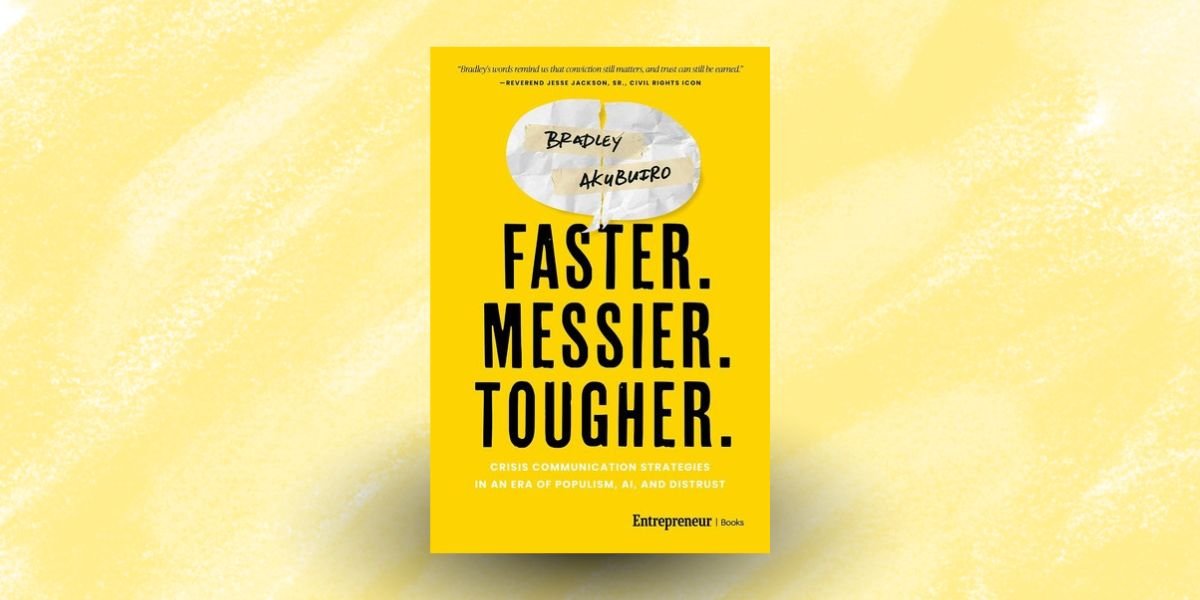
Faster. Messier. Tougher. is built around three words that describe the modern communications environment, and of those three, Bradley believes one is most consistently underestimated by the leaders who encounter it.
Not faster. Most leaders understand that news travels faster than it used to.
Messier.
The Complexity Nobody Is Ready For
What leaders underestimate, Bradley says, is how many different narratives now emerge simultaneously when something goes wrong. Organizations are no longer responding to a single headline. They’re responding to social media, influencers, employees, advocacy groups, competitors, AI-generated content, traditional media, and countless individual interpretations happening at the same time, all of them shaping public perception before any official response has been formulated.
That complexity changes everything about how organizations need to prepare. Speed matters in that environment. But clarity matters even more. The organizations that navigate modern crises successfully aren’t necessarily the fastest to respond. They’re the clearest about who they are, what they stand for, and what they’re doing about it.
The First 24 Hours Have Changed Completely
The first 24 hours of a crisis used to be primarily about gathering facts. Now they’re also about identifying false narratives before they become accepted as truth. AI-driven disinformation has fundamentally changed the early hours of any crisis response, creating a race not just to communicate accurately but to counter misinformation that spreads faster than any organization can respond to reactively.
Bradley’s prescription for this is unambiguous. Organizations need clear monitoring capabilities, rapid decision-making processes, predefined crisis teams, trusted internal communication channels, and an agreed-upon process for responding to misinformation. You cannot build those capabilities while the crisis is already unfolding. Preparation has become a competitive advantage in a way it simply wasn’t a decade ago.
What AI Can And Cannot Do
Bradley holds an informed and specific view on artificial intelligence’s role in crisis communication. AI will dramatically improve how quickly organizations can monitor conversations, analyze sentiment, identify emerging risks, and draft initial communications. Those are genuine and valuable capabilities that organizations should be actively developing.
What AI cannot replace is judgment. It cannot determine what an organization’s values require in a difficult moment. It cannot decide what accountability should look like. It cannot express genuine empathy on behalf of a human organization dealing with real human consequences.
Technology should accelerate preparation. It should never replace leadership. That distinction is simple and critical, and the leaders who blur it are the ones who end up with communications that are fast and technically competent and completely unconvincing.
Crisis Readiness As Organizational Capability
Bradley is direct about what it means for an organization to treat crisis readiness as a core competency rather than a contingency plan. It can’t live in a binder on a shelf. It has to become something the organization actually practices.
That means communications, legal, operations, HR, security, and executive leadership working together before anything goes wrong. It means establishing clear decision rights, investing in scenario planning, and making reputation a board-level conversation rather than simply a communications department responsibility.
Organizations that consistently respond well to crises don’t improvise. They rehearse. And the difference between an organization that has rehearsed and one that hasn’t is visible to every audience watching within the first few hours of a crisis breaking.
What A Crisis Always Exposes
The observation that stays with Bradley most, borrowed from Southwest Airlines executive Whitney Eichinger, is that crisis doesn’t build culture. It exposes it.
A crisis reveals whether trust already existed inside an organization. Whether leaders collaborate or operate in silos. Whether difficult conversations happen early or are avoided until they become headlines. Whether people feel empowered to raise concerns before they reach the public.
Crisis preparedness, in the deepest sense, is simply culture under pressure. The organizations that respond best are almost always the ones that were healthy before the crisis ever began.
If your organization is still treating crisis as an occasional event rather than a permanent operating condition, Faster. Messier. Tougher. by Bradley Akubuiro is available now on Amazon. The playbook has changed. The leaders who know that are the ones who survive what comes next.