
By: Jesi Cruz
You need cash to keep the business running smoothly. Maybe payroll lands two days before your biggest client pays. Maybe a supplier is offering a discount if you buy in bulk this week. Maybe you simply want a safety net.
Two products dominate this conversation: the business line of credit and the working capital loan. They sound similar, and both address short-term needs, but they behave very differently. Picking the wrong one can mean paying for money you never use, or scrambling when you need more flexibility than a lump sum provides.
Rather than starting with definitions, let’s start with situations.
Scenario A: The Landscaping Company With Lumpy Cash Flow
Darnell runs a twelve-person landscaping and snow removal business. Revenue is strong overall, but it arrives unevenly. Commercial clients pay on 45-day terms, fuel and payroll hit weekly, and equipment repairs pop up without warning.
Darnell’s need is recurring and unpredictable. Some months he needs $10,000 to cover a gap; other months he needs nothing at all. A lump sum would sit idle part of the time while he paid interest on all of it.
Better fit: a line of credit. He can draw what he needs, repay when clients pay, and draw again. Interest accrues only on the outstanding balance. Over a year, he might borrow and repay the same $25,000 several times, effectively using far more financing than the limit itself while paying for only what he actually uses.
Scenario B: The Bakery Seizing a One-Time Opportunity
Priya’s wholesale bakery just landed a contract with a regional grocery chain. To fulfill it, she needs an additional mixer, a second delivery van, and three months of extra ingredients and labor before the first invoices are paid. Total need: about $70,000.
Priya’s need is defined and one-time. She knows exactly how much she needs, what it is for, and when the contract revenue will begin paying it back.
Better fit: a working capital loan, possibly combined with equipment financing. A lump sum with a fixed repayment schedule lets her plan precisely. The mixer and van might be financed separately with equipment loans, which typically offer longer terms since the equipment secures the debt. The working capital portion covers ingredients and labor until the grocery chain’s payments start flowing.
Scenario C: The Consulting Firm Wanting a Safety Net
Elena runs a marketing consultancy with steady monthly retainers. She doesn’t have an immediate need, but she remembers how stressful it was when a major client paused work for two months last year.
Elena’s need is precautionary. She wants access to funds without paying for money she isn’t using.
Better fit: a line of credit, opened while business is healthy. Lenders are generally more willing to extend credit when revenue is strong. An unused line typically costs little or nothing beyond a possible annual fee, and it is there when an unexpected slowdown arrives. Trying to open the same line during a downturn would likely be harder and more expensive.
Scenario D: When Neither Product Is the Answer
Marcus owns a small auto repair shop that has lost money for three straight quarters. Rent is behind, and he wants a loan to catch up.
Marcus’s situation is different. His problem is not timing; it is profitability. Borrowing to cover ongoing losses usually postpones the reckoning while adding interest and fees. Neither a line of credit nor a working capital loan fixes a business model that is not covering its costs.
Better first step: a hard look at operations. Marcus may need to adjust pricing, cut expenses, renegotiate his lease, or speak with a small business advisor or local development center. Once the business is stable again, financing can support growth rather than masking decline.
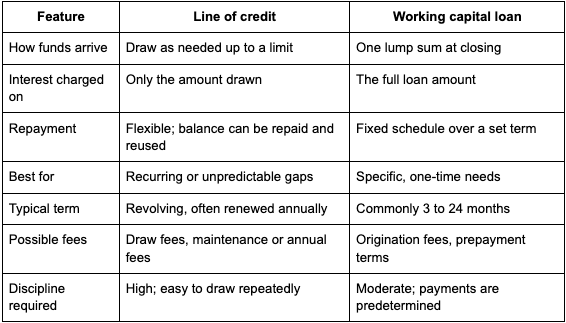
The Core Differences
Questions to Ask Yourself
Work through these before deciding:
Is the need one-time or ongoing? One-time needs lean toward a loan. Ongoing needs lean toward a line.
Do I know the exact amount? Precise amounts suit loans. Uncertain or fluctuating amounts suit lines.
How will I repay it? If repayment depends on specific incoming revenue, either can work. If repayment depends on general business performance over time, a structured loan may provide helpful discipline.
How disciplined am I with revolving credit? Lines of credit are convenient, which is both their strength and their risk. Some owners find themselves drawing repeatedly without a plan for paying down the balance. A fixed loan removes that temptation.
What will the money produce? Financing should generate a return, either by funding revenue-producing activity or preventing a costly disruption.
Costs Worth Understanding
Both products can come from banks, credit unions, or online lenders, and pricing varies widely.
For lines of credit, look at the interest rate on drawn balances, whether the rate is variable, and any draw fees, maintenance fees, or annual renewal fees. Some lines require periodic “clean-up” periods when the balance must be paid to zero.
For working capital loans, look at the APR, origination fees, total repayment amount, payment frequency, and whether paying early reduces your total cost. Some short-term lenders use factor rates instead of interest rates, which can make costs harder to compare.
A useful exercise is to model both products against the same need. Estimate how much you would draw on a line over a year and for how long, then compare the resulting interest and fees with the total cost of a lump-sum loan. The cheaper option on paper is not always the cheaper option in practice.
Educational resources like Best Working Capital Loans break down how these short-term products are typically structured, and Business Loans IQ provides helpful explanations of the terminology you will encounter in offers.
Before You Apply: Do the Research
The difference between a helpful financing experience and a frustrating one usually comes down to preparation. Start by reviewing your last twelve months of cash flow to understand when gaps occur and how large they are. Then research which lenders offer the product you need to businesses of your size, age, and industry.
Pay attention to minimum requirements, typical credit limits or loan amounts, funding speed, and what existing customers say about service. Comparison platforms such as Compare Small Business Loans and directories like Business Loans Companies can help you understand which providers tend to fit different business profiles.
How Should You Approach Applications?
Once you have narrowed the field, apply selectively rather than broadly. Submitting many applications at once can trigger multiple hard credit inquiries in a short period, which may lower your credit score. Some lenders offer prequalification with a soft credit check, so ask about it before you formally apply.
A small number of applications also makes offers easier to compare. Line up the rate, fees, total repayment amount, and payment schedule for each one, and ask lenders to clarify anything that is unclear. If your first choice does not work out, ask for feedback and bring a stronger application to the next lender on your list.
Can You Use Both?
Absolutely. Many well-run businesses use a line of credit for everyday fluctuations and a term or working capital loan for specific investments. Priya, the baker from Scenario B, might open a modest line of credit once her new contract stabilizes, giving her a buffer for future opportunities. Darnell might take an equipment loan when it is time to replace his oldest mowers, keeping his line free for operating needs.
The key is assigning each product a clear job and avoiding overlap that creates unnecessary debt.
The Takeaway
Choose a line of credit when your needs are recurring, unpredictable, or precautionary, and you have the discipline to repay draws promptly. Choose a working capital loan when you have a specific, one-time need with a clear amount and a defined plan for repayment.
Whichever direction you go, research thoroughly, understand the full cost, and apply selectively to the lenders that fit your business best. That combination of clarity and focus helps short-term financing support the business instead of straining it.
Disclaimer: This article is for informational and educational purposes only and should not be considered financial, legal, or professional lending advice. The scenarios presented are hypothetical and intended to illustrate general financing considerations. Loan terms, interest rates, fees, eligibility requirements, and repayment conditions vary by lender and individual business circumstances. Readers are encouraged to conduct their own research and consult a qualified financial advisor or lending professional before making financing decisions. The inclusion of third-party websites or resources does not constitute an endorsement or guarantee of their accuracy, reliability, or services.