

When you’re in a hurry, your attention naturally goes to how you’ll get the money. It should go first to how you’ll get out of the debt. Same-day products differ most in how they expect to be repaid, and the wrong repayment path can make a useful loan into a recurring problem.
So this selection guide works backward. Start by naming one of three exits, then choose the kind of lender that suits it. All examples are illustrative and use fictional companies, and same-day funding is possible only for qualified applicants under the right conditions.
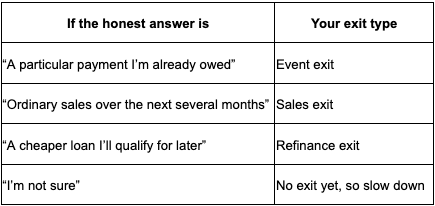
Name Your Exit in Sixty Seconds
Answer one question: What specific event will end this debt?
Knowing who you’re dealing with belongs at the start of any urgent search, since haste is when people skip that step. A company’s own background page, such as Fundivi company background for hurried owners, is one place to begin, but confirm any company’s details independently through a state registry and a phone number you found yourself.
Exit Type 1: The Event Exit
You’ve got a dated, identifiable source of repayment: a signed invoice, an insurance payment, a tax refund, a closing, or a deposit on a large order.
What to Look For in a Lender
- A short-term or single-payment option
- No minimum interest period, or one that’s shorter than your expected wait
- A clear payoff process and same-day payoff quote
- Reasonable pricing if the event comes late
Invoice financing may also fit this exit, particularly if your customer is a creditworthy business.
Illustrative Example
Alder Signworks is owed $26,000 by a hospital system, with payment expected in 30 days. It needs $18,000 today to cover materials on the next job. A provider charges a flat 4%, or $720, for a single repayment of $18,720.
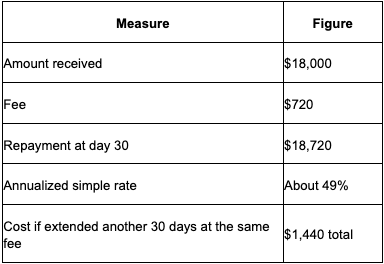
The annualized rate looks alarming, but a $720 cost can be easy to justify when it unlocks a profitable job. The danger is lateness. Before signing, phone the customer’s payables department and confirm the payment date.
Red flag for this exit: Daily debits that start tomorrow, because they begin taking your cash long before the event you’re counting on.
Exit Type 2: The Sales Exit
Your repayment comes from normal operations, with no single event to lean on. Most same-day products are designed for this exit, including merchant cash advances and short-term loans with daily or weekly payments.
What to Look For in a Lender
- Payments your typical week can actually support
- Collection that adjusts if sales decline, or a clear reconciliation process
- A stated early payoff benefit
- A smaller amount, since each dollar borrowed adds to the drain
Platforms with several capital sources may be able to show more than one product for this exit. This Fundivi press release on its hybrid lending platform, carried by USA Today, describes one arrangement of that kind. Having a wider range of products doesn’t remove the need to test your own numbers.
Illustrative Example
Poppy Lane Salon needs $35,000 to replace damaged stations after a leak. It’s offered an advance with a 1.30 factor and 120 daily payments.
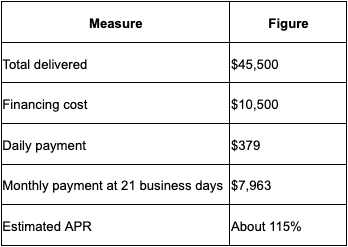
The salon normally has $11,000 in monthly cash left after expenses. Once the $7,963 is deducted, $3,037 remains. That’s survivable in a normal month, and it gets tight if a stylist leaves or a slow month hits.
Red flag for this exit: A “low daily payment” that exists only because the term has been extended and fees have been added.
Exit Type 3: The Refinance Exit
You need money today and expect to qualify for something cheaper soon, like a bank loan, an SBA-backed product, or a line of credit. This exit is the most optimistic of the three, so it needs the most evidence.
What to Look For in a Lender
- Interest that declines as the balance falls
- No prepayment penalty
- Prompt payoff letters and lien releases
- Reporting or documentation that could support your next application
Illustrative Example
Beacon Hill Dental Lab borrows $60,000 for six months, and it hopes to refinance after four. It weighs two structures, each with a 3% upfront fee of $1,800.
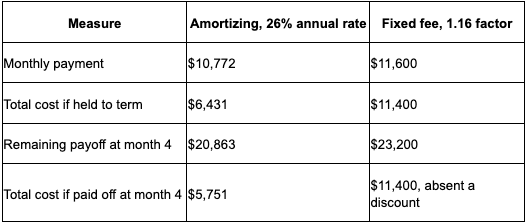
Refinancing early saves the amortizing borrower $680. With the fixed-fee product, it saves nothing unless a discount is written in the contract. Same exit, very different product fit. Before relying on this path, ask the refinancing lender how long it wants to see payments made on the bridge debt.
Red flag for this exit: A plan assuming a bank will approve you soon, without anyone at a bank having said what it needs. Ask first. Then read about options in the wider market, for example through the BusinessLoansCompanies.com business loan comparison guide, to see which products could serve as a realistic next step.
The Three Exits Side by Side
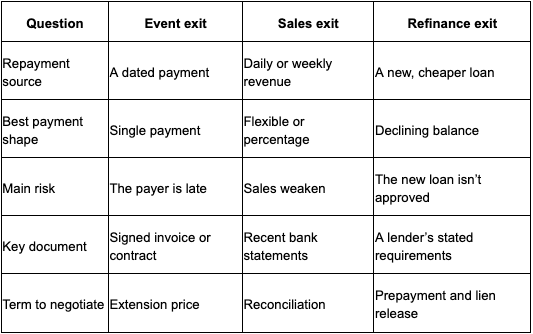
If two columns seem to describe your situation, plan around the one that would hurt most if it failed. An owner counting on a refinance who is really repaying from sales needs to test the sales math first, because that’s what the account will actually face next week.
When No Exit Is Available
If you couldn’t name an exit, you’re likely facing a structural shortfall instead of a timing gap. Fast debt tends to make those worse. Before you borrow:
- Call your largest creditors and ask for a short extension
- Ask customers for deposits or partial early payments
- Sell or return slow inventory
- Talk to an accountant, a Small Business Development Center adviser, or a nonprofit lender
Even a few days gained this way may help you find a real exit, or show that cheaper money is reachable. A deadline that feels absolute at nine in the morning sometimes turns out to be flexible after one honest phone call.
Picking Quickly With Your Exit in Hand
Once you’ve named the exit, screening goes faster because the question changes from “who can fund me?” to “who supports the way I’m going to repay?” Ask each candidate the same three things: when collection starts, what early payoff actually saves, and what happens if the exit runs late. Broader surveys can suggest candidates, and this survey of sought-after business lending platforms describes a range of platforms. Popularity doesn’t indicate fit, so hold every name up to your exit. Write that exit on the top of your application notes and repeat it on every call, since a clear statement of how you plan to repay often leads to a more useful offer.
Frequently Asked Questions
Can a business really get funds the same day?
It can be possible for qualified applicants who apply early with full documents, but it depends on verification and transfer cutoffs.
What if your exit could be either sales or refinancing?
Choose based on the more conservative one, usually sales, and treat refinancing as a bonus.
Is an event exit always the safest?
It’s usually the clearest, but only if the event is documented and the payer is reliable.
Should you borrow extra in case the exit slips?
Rarely. Secure an extension right or a cash cushion instead of paying for extra capital.
Do you need to tell a lender your exit?
Good lenders commonly ask. Be accurate, because the wrong structure can hurt you.
Can you change exits after signing?
You can, but your contract’s payment structure won’t change without the lender’s agreement.
Disclaimer: This article is for informational purposes only and should not be considered financial or professional advice. The information provided is general in nature, and individual circumstances and outcomes may vary. Readers are encouraged to conduct their own research and consult a qualified professional before making financial decisions.