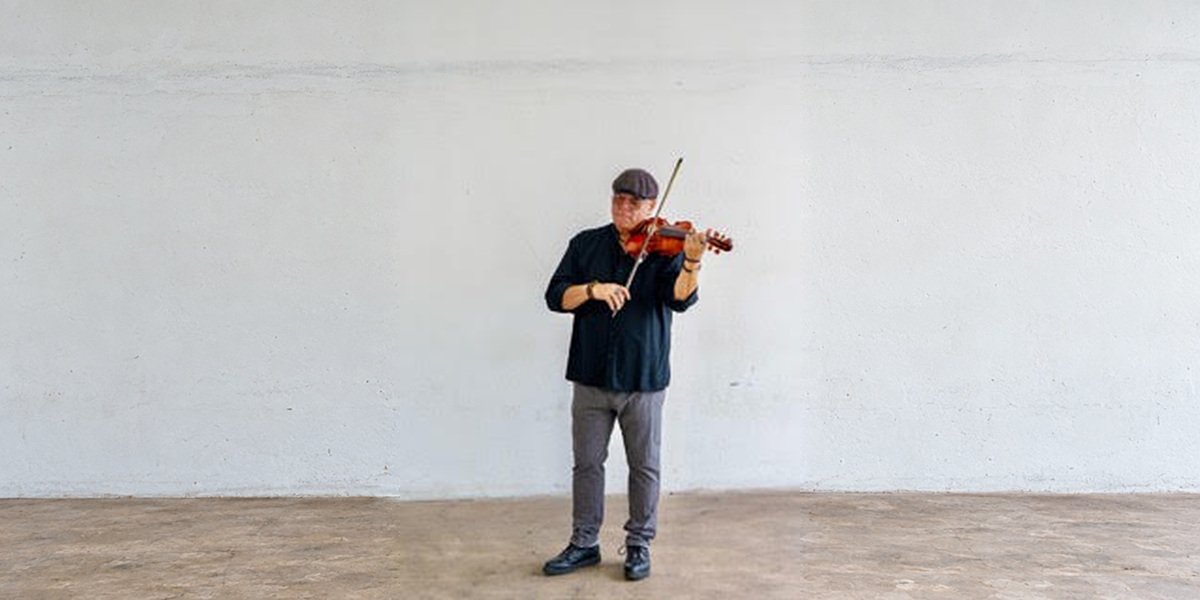

Before Jesús Florido became known internationally as a violinist, composer and producer, he was a young student in Venezuela learning what music could make possible.
That early experience became more than a chapter in his biography. It became a foundation for the educational philosophy that would later shape his work with young musicians and teachers around the world.
Studying music opened Florido’s eyes and ears to the world. It inspired him to dream while also helping him realize how small the world could be. One of his earliest lessons was that music speaks to anyone who stops to listen. To him, music is a universal language.
Florido’s career has increasingly combined professional performance with teaching, workshops, residencies and mentorship, reflecting his belief that musical education should extend beyond technical instruction.
An Early Education That Shaped a Career
Florido was born in Venezuela in 1966 and became involved as a child with the National System of Youth and Children’s Orchestras, the program later known internationally as El Sistema.
The experience gave him an early introduction to ensemble playing and to the idea that structured musical education could influence a young person’s future.
Florido also began teaching at the age of 13. As El Sistema was getting started, there were not enough teachers, and his first teacher assigned him a group of beginner students to teach. Under his teacher’s guidance, Florido developed a love for teaching that would remain with him throughout his career.
After many wonderful experiences and a few that were less positive, Florido decided that he would become “the teacher I always wanted to have.” That became his guiding principle as an educator: to be a knowledgeable teacher who imparts sound technical principles while also being caring and supportive, without compromising the discipline and fundamental principles needed to succeed.
His later career took him from Venezuela to the United States, where he continued studying violin performance and composition. He attended Indiana University and Butler University and developed interests that eventually expanded into film composition, improvisation and cross-genre performance.
Yet his connection to education never disappeared. Instead, the experience of being a student became part of the way he approached teaching.
Teaching Beyond the Traditional Classroom
Florido’s educational work has extended beyond conventional private lessons.
According to his biographical materials, he has conducted workshops and educational residencies in countries including Venezuela, Brazil, Spain, Canada, Germany, Austria, France, Belgium, Japan, Hong Kong and the United States.
The international scope of those activities reflects an approach to music education that is not restricted to one national tradition.
His teaching frequently incorporates improvisation, rhythm and styles outside the conventional classical curriculum.
As a young teacher in Venezuela, Florido had to become creative about keeping his students interested. Introducing other styles of music, including folk music, became a way of motivating his young students. Incorporating modern techniques gradually became a normal part of his teaching approach.
That aspect of his work has attracted attention from educators working with orchestral students. A 2021 article about orchestra educator Matt Manweiler’s collaboration with Florido described the project as involving orchestral arrangements, educational residencies and coaching for classically trained teachers exploring improvisation and groove-based playing.
The emphasis is significant. Many young string players receive extensive training in technique and repertoire but comparatively little exposure to improvisation or contemporary musical styles. Florido’s work attempts to widen that vocabulary.
Connecting Classical Training With Contemporary Music
The central idea behind Florido’s educational approach is consistent with his own career.
He never expected that thinking outside the box would have such a profound effect on his professional career. It gave him what he describes as a larger color palette, with more colors than the average violinist.
His professional work has crossed classical music, Latin traditions, jazz, rock and studio production. His album Heading North brought several of those influences together, while his work with artists and ensembles has required him to adapt the violin to very different musical environments.
The French violinist Jean-Luc Ponty, whom Florido met as a boy in Venezuela and who later became a mentor, encouraged him to embrace that full range of expression when Florido was working on the album. Ponty advised him to “show all your colors” and not be afraid to be himself, reminding him that there is only one version of him.
That experience gives Florido a different perspective when working with students. Instead of treating classical technique as the endpoint, he has used it as a foundation from which musicians can explore other forms of expression.
The concept also appears in his work with professional educators. His collaboration with Manweiler, for example, was intended to help classically trained teachers incorporate elements such as groove and improvisation into their teaching.
In that sense, Florido’s educational work reaches beyond individual students. It can also influence the teachers responsible for introducing new generations of musicians to the string repertoire.
Building an Educational Platform and a New Definition of Success
Florido attributes much of his journey to the many mentors and supporters who helped him throughout his career. He sees himself as standing on their shoulders and has made it his mission to pay that support forward.
He tries to bring that principle into every lesson, workshop and masterclass he conducts around the world.
Florido later established Latinfiddler Music Productions, a Los Angeles-based organization that has served as an umbrella for aspects of his music production and educational residency work. He also founded the Más y Más Music Foundation, an organization focused on music education and career development for young musicians, particularly those from underserved communities.
The development of these organizations reflects a broader transition in Florido’s career. His work is no longer limited to what happens when he picks up a violin. Through education and mentorship, he has sought to create opportunities for musicians to develop professional skills, broaden their musical perspectives and understand careers in music beyond the traditional performer model.
That distinction matters in an industry where aspiring musicians often receive extensive artistic training without comparable preparation for the realities of building sustainable careers.
Florido’s own career provides an example of the range that can exist within a musical profession. He has worked as a performer, recording artist, composer, producer and educator. His credits include studio work, film composition, international teaching and collaborations with artists from different musical traditions.
A young violinist does not necessarily have to choose between being a classical performer, improviser, studio musician or teacher. Those identities can overlap. A 2025 podcast appearance on Athletes and the Arts discussed Florido’s development from a competitive tennis player into a professional violinist, composer, producer and entrepreneur, while also examining his work developing music careers through the Más y Más Music Foundation.
The conversation illustrates how Florido’s professional experience has expanded beyond performance into mentorship and career development.
Passing the Opportunity Forward
The story of Florido’s educational work ultimately comes back to where his musical journey began.
As a young musician in Venezuela, he benefited from an environment that gave him access to musical training and performance opportunities. Decades later, his work with students and educators has focused on creating similarly expansive possibilities for others.
His international workshops, residencies and educational initiatives form another chapter in a career that has consistently resisted strict divisions between musical disciplines. For Florido, teaching is not separate from being a professional musician.
It is part of the same mission. Technical mastery can be a starting point rather than a boundary, and a career with the violin can extend into performance, composition, production, improvisation, education and collaboration.
His goal is to open doors, break glass ceilings and pave roads so that young players can go further than he has gone. That idea may be one of the most enduring parts of his work, using the experience gained on stages and in studios to help the next generation discover possibilities of its own.