
By Rich Christian
Pop music has spent decades telling us how love feels. It makes our hearts race, breaks them into pieces, sends us dancing into the night, and occasionally convinces us to text people we should have forgotten years ago. But Dallas-based singer-songwriter Shweta Harve has a different question: What if love isn’t something we feel so much as something we do?
And what if the best example isn’t another human being?
What if it’s a tree?
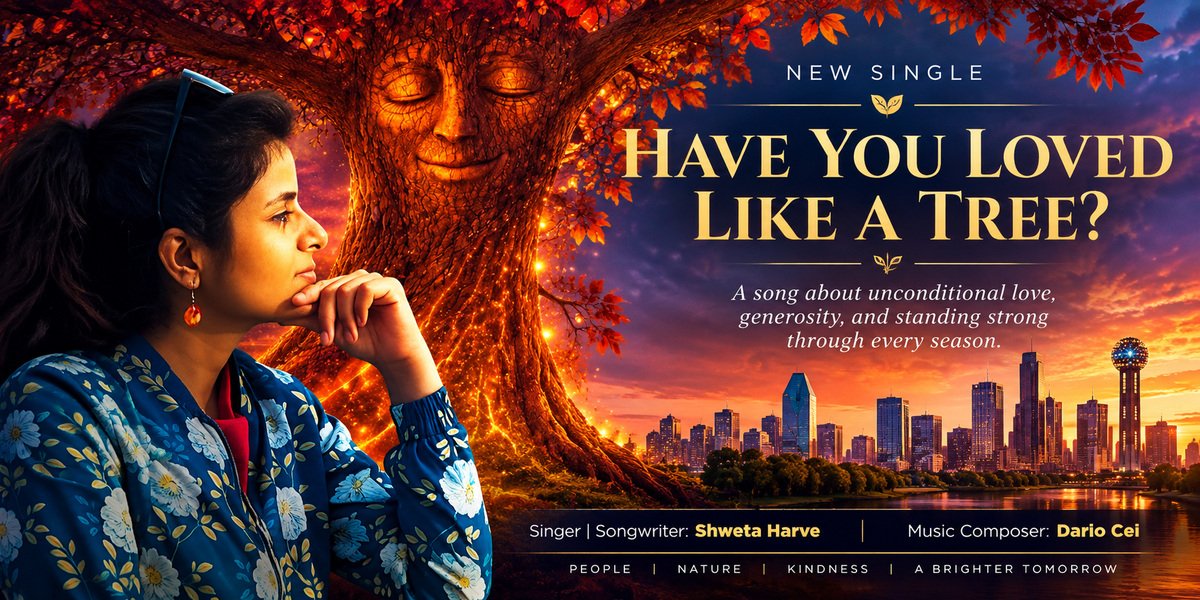
That’s the wonderfully peculiar premise behind “Have You Loved Like a Tree?”, Harve’s contemplative single with composer Dario Cei, a recording that challenges pop’s emotional vocabulary without attempting to reinvent its musical machinery. The song isn’t interested in romantic fireworks. It wants to talk about generosity, patience, endurance, and the possibility that genuine affection might involve giving something without expecting anything back.
In contemporary pop, that’s practically a radical proposition.
Consider the cultural environment into which this song arrives. We’re living through an age when nearly everything is measured. Social media counts our approval. Streaming platforms quantify our attention. Dating applications transform attraction into an endless marketplace of possibilities. Even personal kindness can become an opportunity for public recognition.
Somewhere in that noise, Harve has found a tree.
Her metaphor works because it’s almost aggressively uncomplicated. Trees provide shade. They offer shelter. They survive storms and endure changing seasons. They grow without demanding applause, and their generosity isn’t dependent on whether anyone notices.
Harve wonders why human beings have such difficulty behaving similarly.
It’s a question that could have collapsed into inspirational greeting-card territory. And, occasionally, the song’s earnestness approaches that boundary. But there’s something appealing about an artist willing to risk sounding uncool in pursuit of a meaningful idea.
Harve isn’t hiding behind irony. She isn’t disguising her intentions with fashionable cynicism. She’s presenting a question and asking listeners to take it seriously.
Musically, “Have You Loved Like a Tree?” inhabits a reflective adult contemporary landscape, favoring an approachable melodic sensibility over dramatic production gestures. The arrangement supports the song’s contemplative ambitions, leaving the central message room to develop rather than competing with it for attention.
That restraint is both an advantage and a limitation.
The song’s measured presentation reinforces its central argument about patience and stillness. Yet the recording could benefit from more musical friction. An unexpected harmonic turn, a more assertive rhythmic passage, or a dramatic change in dynamics might introduce the tension that makes great pop music feel genuinely alive.
After all, trees don’t merely stand peacefully in picturesque landscapes. They bend beneath violent winds. Their branches break. Their roots fight through unforgiving ground.
There’s drama inside Harve’s metaphor that the music could explore more aggressively.
Still, the single’s greatest strength isn’t necessarily its arrangement. It’s the consistency of the artistic thinking behind it.
Harve previously attracted national radio attention with “What the Troll?”, which reached No. 26 on the Mediabase Adult Contemporary chart. That song examined online trolling, cyberbullying, and the strange transformation that occurs when people interact through screens instead of looking one another in the eye.
The relationship between these recordings is fascinating.
“What the Troll?” investigates the machinery of disconnection.
“Have You Loved Like a Tree?” searches for an alternative.
One examines the cruelty people become capable of when technology removes immediate human consequences. The other proposes a model of love based on stability, generosity, and connection to the natural world.
Taken together, they suggest that Harve isn’t simply writing topical songs. She’s constructing a musical philosophy.
Her earlier “Why So Busy?” belongs to the same conversation. That recording questions the modern obsession with productivity, the assumption that perpetual activity somehow proves a person’s worth.
Across these songs, Harve repeatedly challenges contemporary life’s most familiar habits.
Why are we always rushing?
Why do we treat strangers so cruelly online?
Why do we expect love to function like a transaction?
These aren’t complicated questions. That’s precisely why they can be uncomfortable.
The most interesting thing about Harve’s songwriting may be its refusal to accept that familiar behavior is necessarily reasonable behavior.
And in a popular music culture increasingly shaped by algorithms, that’s a worthwhile instinct.
There is, of course, a difference between making a meaningful statement and making an unforgettable record. Harve’s next artistic challenge will be finding musical arrangements as surprising as her lyrical premises. The conceptual originality is already there. Greater sonic experimentation could turn that originality into something even more compelling.
But “Have You Loved Like a Tree?” accomplishes something that many louder, more fashionable singles never manage.
It leaves behind a question.
Not a catchy phrase engineered for fifteen seconds of attention. Not a manufactured emotional climax. A question that becomes increasingly difficult the longer you consider it.
Have you loved someone without demanding repayment?
Have you provided shelter when another person needed it?
Have you remained present through somebody else’s difficult season?
Harve doesn’t pretend to possess all the answers.
Instead, she points toward something growing outside the window.
And perhaps that’s enough.