
By: Christian Cooper
Andres Kuusk’s Lessons From Losing
Andres Kuusk has won seven World Pentamind Championships, built a successful career in business and leadership, taught Game Theory, and written extensively about decision-making and performance.
But if you ask him what shaped his thinking most, the answer is not winning. It is losing.
Not because losing is inherently valuable. Most failures are frustrating and unpleasant. But failure has one advantage success often lacks. It forces people to confront reality, exposing the flawed assumptions that success tends to reinforce.
Over a career spanning mind sports, academia, entrepreneurship, executive leadership, and writing, Andres has had his share of setbacks. Many of the ideas that became Unlocking the Success Puzzle did not emerge from victories. They emerged from mistakes, wrong assumptions, poor decisions, and moments when reality showed that something in his thinking needed to change.
Those lessons shaped his competitive success and the framework he now uses to understand performance, decision-making, and long-term achievement. Here are five of the most important.
Lesson 1: Talent and Hard Work Aren’t Enough
One of the most important lessons Andres learned from losing was that talent and effort alone are rarely enough.
Like many ambitious young competitors, he assumed success came down to ability and effort. Strong performers were more talented, and struggling ones lacked something important. Experience complicated that view.
Throughout his competitive career, he repeatedly met highly intelligent, hardworking people who achieved less than their apparent potential. At the same time, he saw others with more modest natural gifts produce exceptional results. The pattern became impossible to ignore once he examined his own setbacks honestly.
Around the age of twenty-five, he reached a realization that would later become one of the foundations of Unlocking the Success Puzzle. Many of his failures had not been caused by a lack of ability. They came from flawed assumptions, poor decisions, and inefficient approaches to solving problems. The issue was not effort. It was how that effort was being directed.
That insight changed how he thought about performance. Two people can have similar talent, work equally hard, and still reach very different outcomes. The difference often lies in the quality of the decisions made along the way. Neither talent nor effort can compensate for poor judgment. Success is determined less by the resources people hold than by the decisions they make with them.
Lesson 2: Early Failure Is Not Evidence of Permanent Limitation
One of the most damaging mistakes people make is assuming that early results accurately predict long-term potential.
Andres has spent much of his life in environments where performance is measured publicly. In mind sports, results are visible. You win, or you lose, and the feedback arrives fast. What he noticed was that many people drew the wrong conclusions from it.
A poor performance was read as a lack of talent. A setback became evidence of permanent limitation. Instead of viewing failure as information, people viewed it as identity. The conclusion often sounded reasonable. “I tried, and it didn’t work.” “I guess I’m just not good at this.”
The trouble is that early results usually measure something very different from potential. They measure current skill, knowledge, preparation, and decision-making, all of which can improve. Potential reveals itself only over time.
His own career shows the pattern. He has worked in several very different worlds, and in each one the beginning was rarely impressive. There were tournaments he did poorly in, professional challenges that went sideways, and projects that took far longer than expected. Had he judged his potential on those early results alone, he might have abandoned pursuits that later became defining parts of his life.
That experience reinforced an important lesson. Early performance often reveals where you are, not where you can eventually go. Many successful people did not start stronger than everyone else. They succeeded because they read failure differently. Where others saw a verdict, they saw feedback.
None of this means persistence alone guarantees success. Some approaches do not work, and some goals need adjustment. But there is a real difference between changing a strategy and abandoning a goal because of a premature conclusion about your capabilities. Many careers and ambitions end too early, not because people lack potential, but because they mistake an early chapter for the whole story.
Lesson 3: Think in Sequences, Not Moments
One of the biggest strategic advantages Andres developed through mind sports was learning to think beyond the immediate outcome.
Most people evaluate decisions one move at a time. Did it work? Did it fail? The problem is that life rarely operates in isolated moments. Decisions create consequences, but they also create new possibilities, constraints, and future decisions. The real impact of a choice often lies not in what happens immediately, but in what becomes possible next.
Strong players in strategic games think several moves ahead, because a decision may be valuable not for its immediate effect, but because it creates a stronger position for future decisions.
The same principle applies far beyond games. A short-term setback may be worthwhile if it creates a stronger long-term position, and a short-term success may be dangerous if it quietly limits future possibilities.
Andres encountered this trade-off directly. At one point, he left the highest-paid position of his professional life. Viewed in isolation, the decision appeared irrational, since the role was rewarding and carried significant responsibility. The problem was not the immediate outcome. It was the trajectory. The position demanded enormous time and energy, and it would likely have created a path dependency that closed off other directions, including one Kuusk had wanted to explore for years: writing.
A different role offered lower short-term rewards but something he valued more: flexibility. It let him build new skills and begin preparing for a possible transition into authorship. From a short-term view, the original position looked superior. From a sequence perspective, the alternative created more future possibilities, and that shaped the decision.
Game theory sharpened this way of thinking. Instead of asking, “What happens if I do this?” the more useful question often becomes, “What happens next? And then what happens after that?” That shift sounds simple, but in practice, it changes almost everything. The people who consistently make strong decisions are rarely the ones focused on winning today’s battle. They are the ones quietly building a position that wins many future battles as well.
Lesson 4: Question the Assumptions Everyone Else Accepts as True
Many people assume that bad outcomes are caused by poor execution. Sometimes they are. But one of the most important lessons Andres learned from losing was that some of the most expensive mistakes happen much earlier, when a flawed assumption is accepted as fact.
What makes these mistakes dangerous is that they rarely feel like mistakes at the time. The assumption feels obvious, and it often goes unnoticed, so intelligent people spend enormous energy solving the wrong problem.
Andres learned this the hard way during a tournament early in his career. He had spent considerable time analyzing a particular position and believed he had found a clever tactical idea. When a seemingly identical position appeared on the board, he played the move at once, confident his preparation had paid off.
The position was not actually identical. A small but critical difference had escaped his attention. The analysis itself had been correct and the reasoning sound, but it had been applied to the wrong position. Within a few moves, his opponent showed why the idea failed. The mistake was not a lack of calculation. It was an incorrect assumption about the starting conditions.
Many professional and personal mistakes follow the same pattern. People work to improve their analysis when the real problem lies in the assumptions guiding it. Teams and organizations become trapped not because they lack information, but because they have stopped questioning how they interpreted it. Assumptions are often invisible. People question conclusions and outcomes, but rarely the beliefs that produced them.
This is one reason Andres became fascinated by puzzles and mystery novels. In the best of them, the reader has all the necessary facts from the start, and what hides the solution is not missing information but an incorrect assumption about how to read it.
Real life often works the same way. A business keeps pursuing a failing strategy because it assumes market conditions will hold. A leader blames declining performance on employees rather than the system itself. An individual reads a failed attempt as a lack of ability rather than a flaw in the approach. The facts may be visible while the assumption stays hidden.
Kuusk believes many of the most valuable improvements in performance come not from acquiring more information, but from asking a deceptively simple question. What am I assuming to be true? The answer often changes the entire picture.
Lesson 5: Curiosity Matters More Than Confidence
Many people assume confidence is one of the most important ingredients of success. Andres disagrees.
Confidence can be useful. It helps people act under uncertainty and persist through difficulty. But it has a hidden weakness. Confident people stop asking questions, while curious people keep asking them.
Throughout his career, Andres has observed that the strongest performers are not always the most confident. Often, they are the most curious. They keep learning after others stop, and update their understanding of reality while others defend outdated conclusions.
Curiosity creates an advantage because it keeps assumptions visible. A curious person is more likely to ask what they are missing and what can be learned from an outcome. Those questions create adaptation, and adaptation compounds over time.
This was especially visible in mind sports. The competitors who improved the most were rarely those who believed they already understood the game. They were the ones who stayed fascinated by it, who kept studying, experimenting, and searching for ideas they had not met before. The same holds in business, leadership, and personal development. The moment people become convinced they have the answers, learning begins to slow. Curiosity keeps it alive.
Curiosity also changes how failure is experienced. Confident people often treat mistakes as threats to their identity. Curious people treat them as information. One reaction creates defensiveness. The other creates growth.
Curiosity may be one of the most underestimated drivers of long-term success. Discipline matters. Effort matters. Strategy matters. But curiosity determines how quickly all of them improve. It is hard to fulfill your potential in a domain you are not curious about, and equally hard to stop improving in one that fascinates you. Perhaps that is the most important lesson of all. The goal is not to become certain. It is to stay curious long enough to keep getting better.
Most importantly, losing taught Andres that the greatest competitive advantage is not intelligence itself. It is the ability to continuously update how you think.
That idea sits at the heart of Unlocking the Success Puzzle. Success emerges from thousands of decisions made over time, each shaped by the assumptions, habits, and mental models through which people read reality. The cards you are dealt matter, but how you play them matters more.
In poker, every hand has situations in which it can succeed. Strong players understand that their task is not to wish for different cards, but to make the best possible decisions from the position they currently occupy. Life works much the same way. The most successful people are often not those who begin with the strongest hand, but those who learn fastest, adapt quickest, and improve their thinking most consistently.
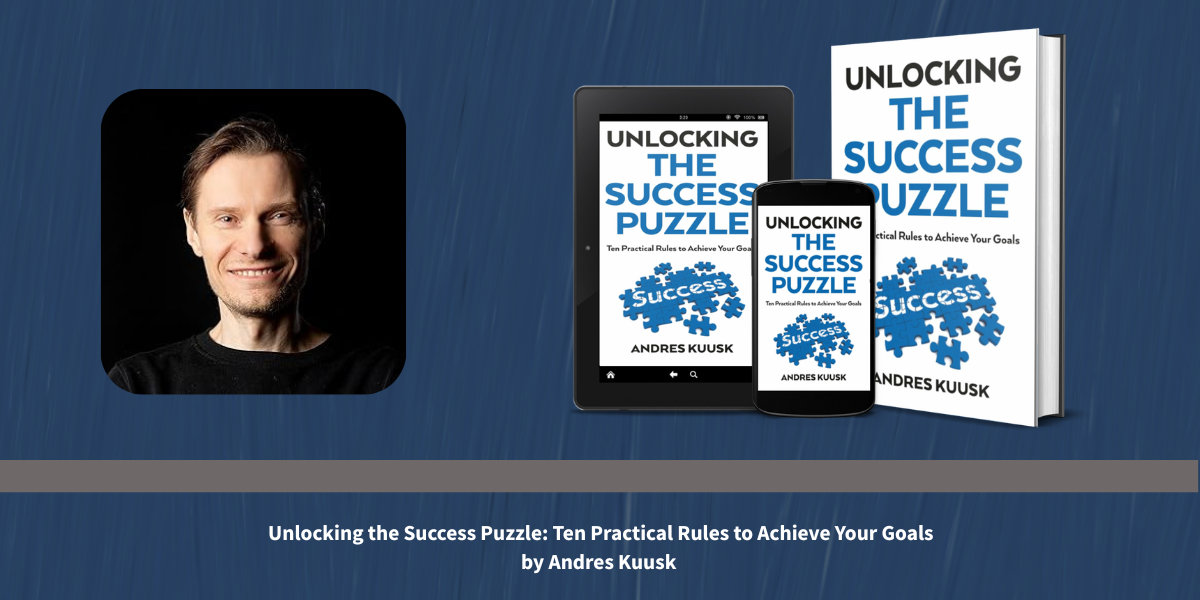
Andres develops these ideas about decisions, distortions, and what separates high performers from everyone else in his book, Unlocking the Success Puzzle: Ten Practical Rules to Achieve Your Goals, which sets out ten rules within a single framework for understanding why capable people win or fall short.