
By: Kate Sarmiento
Sales reports show what happened to a retailer’s own numbers, but they do not show what a competitor did to cause it. When a rival drops a price or kicks off a promotion, shoppers drift, and the first evidence on the retailer’s side is usually a weak week in the figures with nothing attached to explain it. ShopVision is a market intelligence platform for brands and retailers, and it was built around that blind spot.
Price, promotions, assortment, and advertising rank among the biggest levers in retail, and each of them depends on what the rest of the market is doing. A finance person would want to know what it costs when that part of the picture is missing. Some published numbers help answer it.
The Eight Percent Hiding Inside Every Price Point
Take the average S&P 1500 company, as McKinsey & Company did, and a 1 percent bump in price with sales volume holding steady adds 8 percent to operating profit (Source: McKinsey & Company, 2003). The slide runs the other way too, and a 1 percent price drop shaves roughly the same 8 percent off when nothing else changes (Source: McKinsey & Company, 2003). That analysis is from 2003 and describes an average company, so a particular retailer’s margins will land somewhere else. The direction still holds for anyone who sells things at a price.
Extra volume rarely fixes a pricing mistake. To make up for a 5 percent price cut, sales volume would need to rise 18.7 percent in McKinsey’s example (Source: McKinsey & Company, 2003). Each competitor move puts a retailer in front of a choice like that one, with the options of matching the price, holding, or responding some other way. A retailer that never saw the move still answered it, since leaving prices and promotions alone is a decision too.
Rivals can cut deep once the calendar gives them a reason. Black Friday 2025 was the most heavily discounted day of the U.S. online holiday season, according to Adobe, with an average of 23.7 percent off across the categories it measured (Source: Adobe, 2026). A year earlier that average was 22.2 percent (Source: Adobe, 2026). Some categories went well past the average, and apparel discounts peaked at 25.1 percent off list price over the season (Source: Adobe, 2026). Even Thanksgiving Day got deeper, at 22.7 percent against 21.6 percent in 2024 (Source: Adobe, 2026). Rival sale calendars shift from year to year, and looking is the only way to find out how.
Dashboards inside a company can show that a product’s sales slipped. What they can’t show is whether a competitor ran a sale that same week, because the answer sits on someone else’s website. ShopVision says many brands and retailers still rely on spreadsheets, manual searches, and instinct to fill that gap.
Market Intelligence Has to Pick Out the Few Moves Worth a Meeting
Seeing everything doesn’t mean acting on everything. Prices and promotions change all day, and most of those changes won’t touch a given business. A few checks sort the ones that will. The first is how much revenue and margin the product carries. After that comes whether the competitor is one the retailer’s shoppers actually compare against, then how deep the cut goes and whether it looks temporary, and finally whether inventory and margin leave room to respond.
A markdown on a slow accessory from a brand shoppers rarely compare against can wait for the next review. A deep cut on a best seller from a direct rival needs a decision that day.
Any of this depends on knowing which competitor product is the equivalent of yours, and two retailers don’t always share a product code. ShopVision uses AI web agents to get around that. Large language models, the technology behind chatbots, power these agents, and they read competitor and reseller websites in a way that resembles how a person reads them. Where two products share no code, the agents can still pair them, and each pair carries a confidence score and a short explanation of the reasoning. A person can read the explanation and decide whether the match holds.
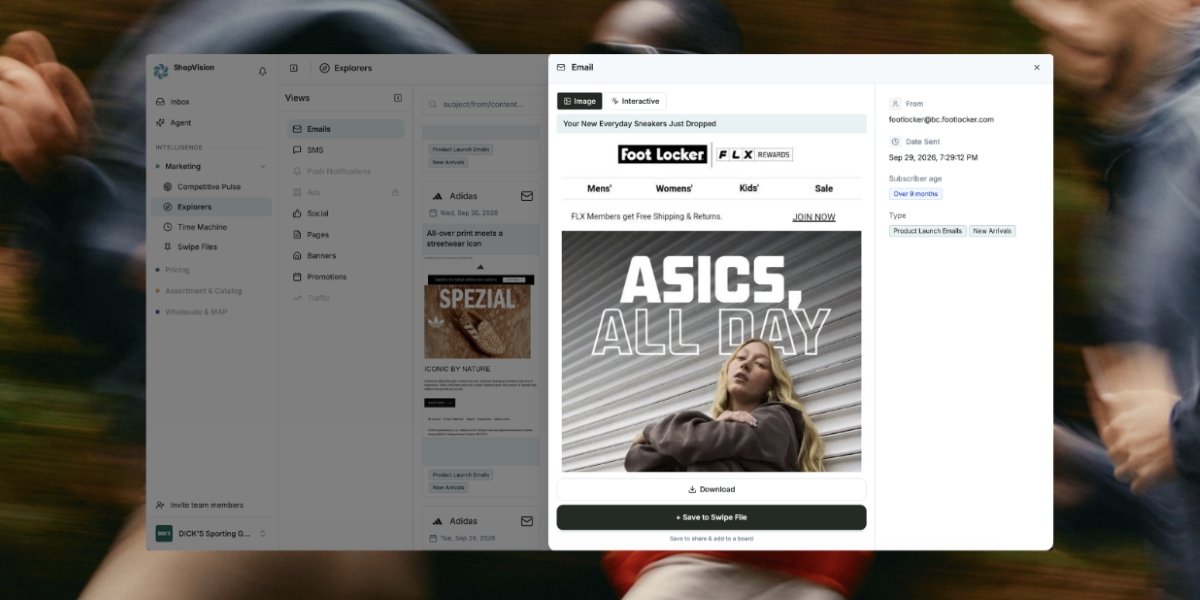
ShopVision says its dataset covers more than 300,000 brands, retailers, and marketplaces, with 15 million products tracked every day. The company sells it as four products. Pricing Intelligence handles competitor prices, which refresh daily, and Marketing Intelligence handles rival ads, emails, and campaigns, shown as they go live. When the question is what a category is launching, dropping, or restocking, Assortment and Catalog Intelligence has it, and Wholesale and MAP Intelligence covers resellers who advertise below a brand’s minimum advertised price, or MAP, with a screenshot and timestamp as evidence. The four share one dataset and matching layer, so a finding in one can add context to the others.
Somebody Still Has to Make the Call Once the Software Has Read the Market
Software like this shows a team what changed and offers a suggested response, and its role stops there. Whether acquisition costs fall or margins hold depends on what people do with the information. Someone who knows the business still has to review the confidence scores and reasoning before trusting a match, and the final decision is theirs.
AI tools are sending shoppers to retail sites too. Adobe saw traffic from generative AI tools to U.S. retail sites jump 693.4 percent year over year during the 2025 holiday season, though it described the user base as still modest (Source: Adobe, 2026). The argument ShopVision is built around goes further, which is that as AI agents take on more commerce tasks, their usefulness will depend on the market information they can reach. That remains a forecast. The company offers a connector, called MCP, that lets approved AI tools query the same market intelligence its human users see.
Put the Blind Spot on the Balance Sheet
Finance teams can test all of this on their own figures. Total the revenue from the products that carry the most margin, then take 1 percent of that total. With sales volume steady, that is what a 1 percent price change is worth in profit. Put it beside what the company spends on watching competitors. If the first number is much bigger, the market picture probably deserves a larger budget and a named owner.
Teams that want continuous visibility can look at a Market and Competitive Intelligence platform such as ShopVision. It covers competitor pricing, promotions, advertising, assortment, and reseller activity, and the Marketing Intelligence Starter plan is self-serve with a 7-day free trial. People who know the business still make the call, and they’ll make it with more of the market in view.