
By: Jessica Suarez
The Statistic That Changes the Conversation
Ninety-five percent of enterprise generative AI pilots fail to show a measurable profit-and-loss impact. That figure comes from an MIT Project NANDA report, and Simon Knight puts it near the center of Business Rewritten not to argue against artificial intelligence but to make a specific point about why sophisticated tools keep producing disappointing results. The problem is not the technology. The problem is that AI, like strategic planning, Six Sigma, SWOT analysis, and process reengineering before it, is being applied to symptoms rather than causes. It is being deployed before anyone has done the harder work of understanding what is actually driving organizational outcomes. That harder work is what Business Rewritten is designed to support.
Why the Real Drivers Go Undetected
Simon identifies three forces that shape outcomes in complex organizations and that conventional analytical tools are structurally blind to. Human dynamics, the behavioral patterns and relationship structures among the people inside an organization, produce outcomes that no process map accounts for. Path dependencies, the accumulated weight of past decisions, constrain present choices in ways that have become so familiar they are no longer examined. Hidden themes, the most invisible of the three, are patterns masked by more obvious factors, cultural assumptions whose downsides are ignored because the assumptions themselves have never been questioned. Organizations are not failing to see these forces because they lack analytical capability. They are failing to see them because the tools they trust are not designed to look for them.
The LEGO Case and What It Reveals
Simon uses the LEGO case study to illustrate how hidden themes operate in practice. LEGO’s difficulties were caused in part by what he describes as uncontrolled innovation, a proliferation of initiatives that strayed from the company’s core strength and proved unprofitable. The reason this pattern went unaddressed for as long as it did is precisely that innovation is supposed to be a strength. The assumption protected the pattern from scrutiny. That is how hidden themes work inside organizations. They are not hidden because the evidence is absent. They are hidden because the assumptions surrounding them prevent the evidence from being recognized as a problem. Business Rewritten is designed to surface those assumptions and examine them honestly.
A Framework for Interconnected Problems
Complex, interconnected problems resist the sequential, departmental approach to change that most large organizations default to, because the cause of the problem is often located somewhere entirely different from where it manifests. A persistent service delivery failure may be rooted in a sales compensation plan that rewards over-promising, creating customer expectations that operations can never meet. Treating the service delivery team as the source of the problem leaves the compensation structure untouched and guarantees the same failure returns. The Business Rewrite Framework is designed to address this by forcing a holistic analysis of the organization’s backstory, examining the full cast of characters involved, their attributes, their motives, and the relationships between them that produce the outcomes currently causing difficulty.
Incremental Change and Fundamental Transformation
One of the clarifications Simon makes in the book is that the Business Rewrite Framework is not reserved for organizations facing existential challenges. The scope of the intervention is determined by the personas defined within the framework, which means it accommodates both incremental improvement and fundamental transformation within the same structure. A leader with a narrow brief can use it to understand a specific recurring problem more clearly. A leader pursuing a full organizational transformation can use it to map the full complexity of what needs to change and in what sequence. Two business leaders who endorsed the book found that even without implementing the full framework, the narrative structure it introduced helped them understand how processes actually worked rather than how they had assumed they did.
Making AI Work the Way It Was Supposed To
The accompanying AI course Simon has developed alongside the book addresses the specific failure modes he identifies most often in AI deployments, including sycophancy, the tendency of AI tools to confirm what the user already believes, and surface narrative bias, the tendency to accept the most visible explanation rather than look beneath it. These are not technology problems. They are analytical problems, and they apply to human reasoning just as much as to machine reasoning. What the Business Rewrite Framework provides is the diagnostic foundation that makes AI a genuinely useful tool, one aimed at the right problems with the right information, rather than an expensive amplifier of the assumptions the organization brought into the analysis in the first place.
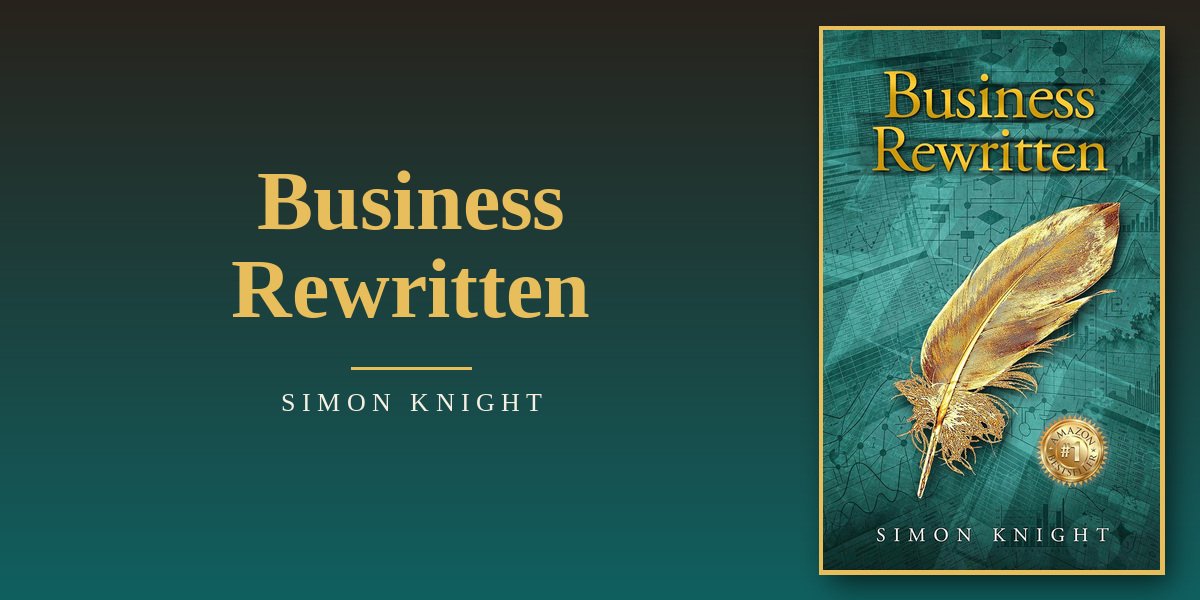
Pick up your copy of Business Rewritten by Simon Knight on Amazon today and discover what your organization has been missing. To take the next step, explore Simon’s AI Courses, which offer practical guidance on addressing common AI pitfalls and applying artificial intelligence more effectively to business challenges. Visit business-rewritten.com/ai-courses to learn more.