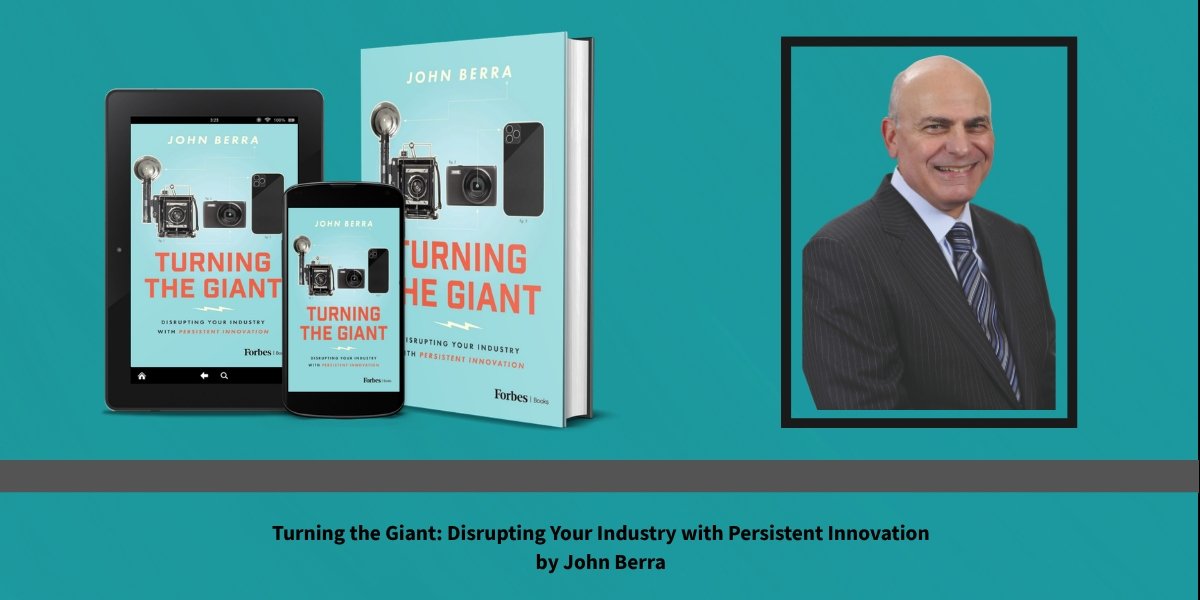

By: Adam Smith
Every leadership book makes a promise, implicitly or explicitly, about what readers will get out of it. John Berra’s Turning the Giant makes an unusually honest one. It doesn’t promise to make obstacles disappear. It promises to change how you relate to the ones that won’t.
John spent his career in industrial automation, eventually becoming Chairman of Emerson Process Management and a member of the Process Automation Hall of Fame. The path there started somewhere far less impressive.
It Started With Wires
Early in his career, working as an engineer at Monsanto, John spent his days on repetitive technical work. Nothing about it suggested it would lead anywhere significant. But the repetition produced something useful: a persistent, nagging thought that there had to be a better way to do things.
That thought didn’t fade with time. It became, in John’s words, properly channeled frustration, and he credits it as one of the most important forces in shaping his career. The job was small. The question it generated wasn’t.
The Giants Don’t Get Smaller
As John moved into bigger roles, first at Fisher-Rosemount Systems and later across Emerson, he expected the challenges to become more manageable with more authority. Instead, the opposite happened. The giants, his term for the recurring obstacles every leader faces, got bigger.
Corporate bureaucracy. Skepticism toward new ideas. Resistance to change. These didn’t shrink with seniority. What changed was John’s approach to them. Early on, the instinct was to push through. Later, it became about redirection, turning resistance into something that could actually move a vision forward rather than simply blocking it.
Doubt Travels With Growth
One of the more candid parts of John’s reflections concerns confidence, or the lack of it. He’s direct that self-doubt showed up at nearly every significant step forward in his career, particularly when he was entering unfamiliar territory or taking on bigger responsibility.
He doesn’t treat this as something to be ashamed of or as a problem he eventually solved. He treats it as a pattern worth recognizing. Growth and doubt travel together. For a leader who eventually reached the top of a major organization, that’s a genuinely useful thing to hear.
Innovation Has No Size Requirement
John also challenges the idea that meaningful innovation is mostly a small-company phenomenon. In his experience, some of the most transformative changes happened inside large, established organizations, the kind that are often assumed to be too slow to change.
The deciding factor wasn’t the organization’s size. It was whether the people inside it were willing to challenge entrenched practices and stick with that challenge through resistance, rather than accepting “the way things have always been done” as a final word.
What to Do With This
John’s most actionable advice is also his simplest. When resistance shows up, don’t reach immediately for either of the two default responses, fighting harder or giving up. Ask instead: how can this be turned?
It won’t make the giant disappear. But according to someone who spent a career doing exactly that, it’s the question that opens up everything else.
Frustration, doubt, bureaucracy, resistance. John Berra has faced all of it and built a career turning every single one. Get Turning the Giant on Amazon and learn how he did it.