

On any given day, the world seems to divide itself neatly into columns: good news and bad, sacred and secular, people we welcome and people we avoid.
We scroll headlines about disasters with the same thumb that taps a heart on a baby picture. We praise the sunrise and curse the traffic that hides it from view. The split feels natural, almost inevitable — as if life were designed to be sorted into piles of “this” and “that.”
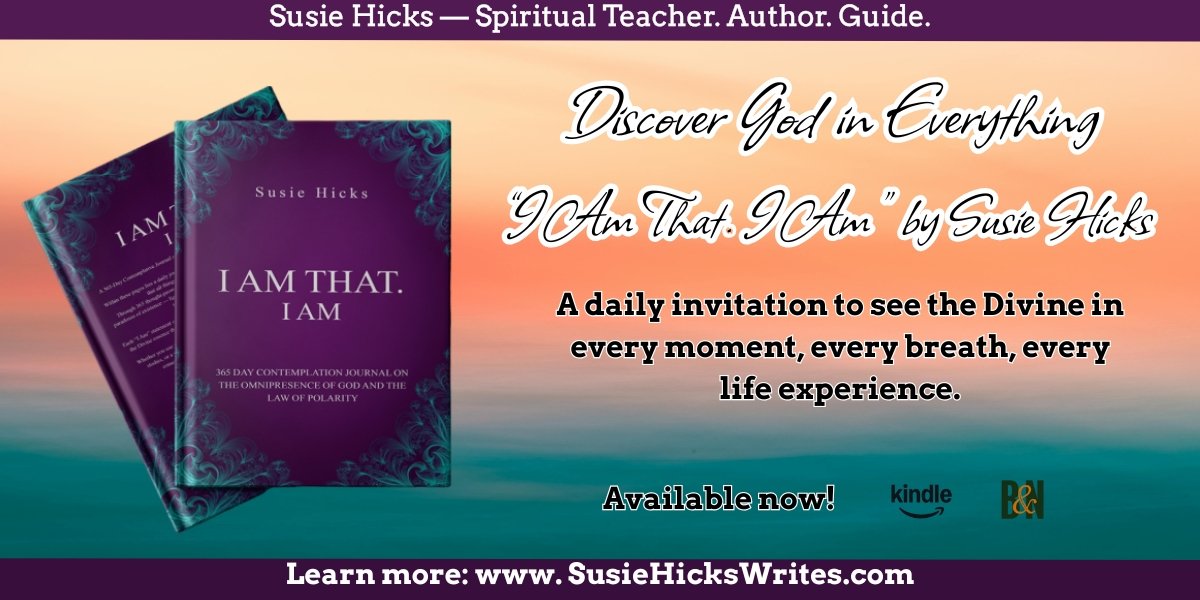
Susie Hicks’s new book, I Am That. I Am: A 365-Day Contemplative Journal on the Omnipresence of God and the Law of Polarity quietly suggests that this split is an illusion. The world, she insists, is not divided at all. It is one continuous field of presence, and that presence — God, Spirit, the Divine, whatever name you prefer — is moving through every contrast we experience, not just the pretty ones.
At first glance, I Am That. I Am looks like yet another entry in the crowded genre of guided journals. Each page offers a brief reflection, an “I Am” statement to meditate on, perhaps to write beneath. But its ambitions are larger than encouragement or productivity. Hicks is after something more dangerous: a fundamental rewiring of how you perceive reality.
Her organizing principle is the “law of polarity,” the mystical notion that every experience carries its opposite within it — joy and grief, presence and absence, faith and doubt.
Instead of inviting readers to rise above these opposites, Hicks asks them to sit in the middle and listen. “I am the light that comforts you,” a passage might imply, “and I am the shadow you fear.” The Divine speaks from both ends of the spectrum at once.
This approach makes for a very different kind of devotional reading. Many spiritual books emphasize ascent: the climb toward higher consciousness, better thoughts, purer emotions. Hicks’s journal moves laterally.
Day after day, she directs your attention not upward but outward, into the ordinary and the inconvenient. God shows up as the child’s laughter and the exhausted parent, the serene morning and the late-night panic, the healing body and the one that won’t cooperate.
Literally, the project leans on repetition. The phrase “I am…” returns on every page, a mantra that anchors the reader as the subject matter widens and darkens. The effect is cumulative. Over weeks, the entries begin to sound like a single long sentence in which the Divine keeps trying on new clothes — some shimmering, some tattered, all insistently part of the same wardrobe.
It is not a book designed for theological comfort. If you prefer your God safely confined to stained glass and ceremonial language, Hicks’s God may feel unruly, even intrusive. Her writing suggests a Presence that will not stay where we put it, that insists on being recognized in the person who irritates us, the memory we’d rather bury, the ache in the joints we resent. To read the journal honestly is to be challenged on the level of spiritual taste: do we want God, or only the version of God that flatters us?
And yet the tone is anything but harsh. Hicks writes as a companion rather than a preacher, trusting short, clear phrases over argument. She borrows names from multiple traditions — Allah, Jesus, Buddha, Spirit — not to flatten them into sameness, but to hint at a shared mystery they all circle.
In that sense, I Am That. I Am feels less like a manifesto and more like a yearlong invitation: what would happen if, just for today, you practiced seeing everything as included?
In a culture that encourages us to curate our lives — blocking, muting, and filtering away whatever disturbs — the book’s insistence on wholeness can feel subversive. It asks you not to “like” or “unfollow” your experience, but to bless it, or at least to look at it without flinching. The spiritual work is not to escape polarity, Hicks suggests, but to recognize that both poles are held within a larger, unwavering Love.
By the time you reach the end of the year, you may not have solved the riddle of suffering or made peace with every contradiction in your life. But you may discover that the line between “this” and “that” has grown thinner, more porous. Anger shows up with a trace of tenderness inside it; beauty carries the echo of loss. And the God you once looked for in rare, elevated moments begins to appear, inconveniently and miraculously, in everything.
Readers interested in contemplative and spiritual literature may find I Am That. I Am to be a reflective companion that explores themes of contrast, presence, and perception. The book is available on Amazon and in independent bookstores, with additional information available on the author’s official website.
Visit: www.susiehickswrites.com
Disclaimer: This article discusses the themes and ideas presented in a religious and spiritual book. The views described belong to the author of the book and are presented for informational and literary discussion purposes only. This content does not endorse or promote any religious belief system.